Showing posts with label writing tips. Show all posts

Tuesday, October 16, 2018

Tipful Tuesday: Got Nothing?

Got guilt? Not squeezing in time to write "each day", as many writing gurus demand for success? Not feeling completely inspired to write that next great scene? Not aware of what that next scene might even be? Don't fret! There are a couple of things I've discovered by jumping over that guilt, and sticking my tongue out to the should-be writing time that just isn't-going-to be:

1. I don't think it's reasonable to expect every day to have writing time in it (especially if you are living in a busy season of life). I always strive for some daily time, but I can't beat myself up for not doing it. It's exhausting to try and be so stringent. It sucks away my creativity and love of story. So, maybe I'm wrong, but, I'd say, don't be guilted into a black and white theory on the timeline of a writer.

2. Just because I'm not writing, doesn't mean my story's not moving forward. In times that I feel stuck, or I just don't have the desire to pour my heart on the page, I'll jot down some outlines, or notes, or even a segment of dialogue that will appear at some point in my story. Even if my word count isn't showing it, my story IS moving forward on non-writing days.

3. Write bad. Yep. If you have the time, and need to just write something to feel confident in your process, just do it. I swear it helps to just write whatever comes out, even if it's going to be slashed in edits. It gets that story-telling muscle moving. My crit partner Ashley Young Clark​ and I always cheer each other on before we delve into brain dump writing, knowing it's not gonna be great, but it's gonna be--and sometimes that's enough to get your story going! Actually, the brain dump writing can become the time when you give up control of the story, and let God direct it in a whole new way.

Thursday, July 6, 2017

Freedom for Writers

This week we celebrated the Fourth of July, and over on the Facebook group we talked about how it's a great time to be a writer because independence is achievable. I wanted to expand on those tips and see what you would add.

1) Know your goals. Why do you want to write indie? What is motivating that decision? The same questions should be asked if you're pursuing traditional publishing. For me, I'm pursing indie for my books where I have received the rights back from the publisher. It's been a huge learning curve, but I know these are good books and there are readers who haven't discovered them. Indie publishing is a way to get them back out there, update them and more. I love traditional publishing, because I love the partnership aspects. I know they have a platform I don't have on my own. They have the team to help me with all the elements that are overwhelming to consider on my own. That's why I love being with the big houses.

2) The most important relationship is between reader and author. Regardless of how you publish, you have to think about how you will build that relationship. Part of it will be writing more, great books. Then there will be websites, social media, booksignings, etc. you will have to think deliberately about how you will build this relationship. It also requires you to know and listen to your reader. Involve them in the process. Help them acquire ownership of your books. How can you help them become your biggest advocates?

3) Hire an editor. This step is so often overlooked. If you are traditionally published, then you should have three rounds of editing: macro/story edit, line edit, and proofing. If you are indie, you need the same. Even though the book I have put up were edited at least three times, I still hired someone to proof each one. It's amazing what is caught each time. The quickest way to lose a reader is to have a poorly edited book. Don't skip this step. It is worth the expense to make the book is done well. As James Scott Bell says you're best marketing is the book the reader is currently reading.

4) Don't rush. Let's face it. We all get important. But let's not rush into print before we're ready. I have friends churning out 4-6 books a year. I can't do that with everything else going on in my world. Three is about my max; four if I'm writing two with Tricia Goyer. I know that's my pace, and I know this after writing 27 books. What's your pace? How fast can you write and still do a good job? Seriously stop and think about. How much time do you need to make sure you're going through the rounds of edits and putting out a great book? Is your first book really ready for the world to read?

What would you add?


An award-winning author of more than twenty books, Cara is a lecturer on business and employment law to graduate students at Purdue University’s Krannert School of Management. Putman also practices law and is a second-generation homeschooling mom. She lives with her husband and four children in Indiana.

Thursday, January 12, 2017

5 Ways to Write More than 1 Book

I have often written multiple books at the same time. It's a part of life when one of your hats is professional writer. But it can also be a real part of the writing journey when you're getting started writing. The challenge is learning how to juggle the multiple characters, plots, and timelines.  Here are a few tips I've developed over the years to let me do exactly that:
[Tweet "Need to write more than 1 book at a time? Overwhelmed? @cara_putman offers 5 #strategies. #amwriting"]
  • Use different music to signal to my brain that I’ve switched times/genres/etc.

Right now I’m writing suspense to an Avengers/movie soundtrack channel I’ve built on Pandora. As soon as it comes on my brain settles down. I use different music for cozy mysteries or WWII historicals. This has worked really well for me over time which is why I listed it first. There's something about the music that lets my mind know immediately which book to focus on in that moment. 
  • Always stop mid scene so I can easily get back into what I was thinking when I stopped writing.

One way to smooth out this process of transitioning from book to book is to make a few bullet point notes of where I saw the scene heading before I end for the day. That alone saves a lot of time and helps me get started quickly when I start the next day or week or whenever I can come back to the story. It also allows me to end knowing that I know where to begin, alleviating the blank page syndrome.
  • Edit what I wrote the day before to get back into the story flow.

This is a great way to get right back into the story. It also helps me to let go of the editing details while I'm writing. If I know I'm going to come back the next day and clean up the spelling and grammar issues, it lets me focus on words on the page. It also helps me get immediately back into the story.  
  • Occasionally I will alternate days, but I don’t always have the luxury.

My friend Lenora Worth does something like this consistently. I loved how she put it:
When I'm working on more than one project, I compartmentalize them. I might work on a suspense in the morning and a romance in the afternoon. Or I pick days and stick to that--suspense on Monday, Wednesday and Friday, other things on Tuesday and Thursday. For a while, I wrote novel length books on weekdays and turned to Indie novellas on the weekend.  Or I'd work on longer books all day and save one precious hour for other projects at the end of the day.
  • Research one while writing the other. 

This last one works well. I like to let my brain think about one book by writing another. It may be researching an idea, reading background books, locating sources, but it's a different kind of creative work that writing. It also allows me the break from an intense focus on one book and allows my subconscious to work on the second book. This process works really well for me. 
If you're feeling the pull to work on two books or have multiple deadlines, I hope these tips help you make that process work. Do you have a different way for writing multiple books? I'd love to read about your tips and strategies. Be sure to leave them in the comments below! Thanks for joining the conversation.


____________________

Wednesday, December 7, 2016

Christmas and My Favorite Christmas Movie Lessons


moviesEver since I researched 1940s Hollywood for Stars in the Night, I've been a bigger fan than ever of classic movies. Growing up, my favorite movies were from the 30s and 40s...that hasn't changed. There's something I love about the simplicity of that time that shines through in movies that make me laugh and feel. So today I thought I'd share a few of my favorites and writing lessons from each.
[Tweet "Love #Christmas? Have you seen @cara_putman favorite Christmas #movies? #traditions"]
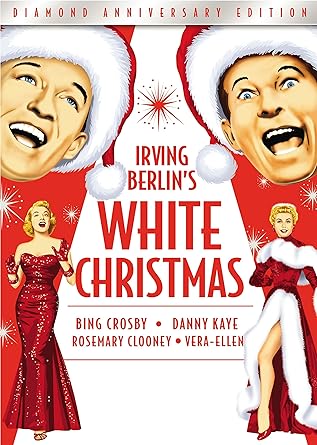
White Christmas: I adore this relatively simple story set during the post WWII years. I love the theme of honoring those we admire...even at great cost to ourselves. The ending scene with the general makes me tear up every time. And hearing Bing Crosby croon White Christmas? And Danny Kaye is the perfect comedic foil. Sing with me "Sisters, Sisters...." Perfection! My family adores this movie. 

  •  The writing tip? Slapstick comedy of Danny Kaye paired with a story of making assumptions about intent, this story makes you feel. And that's what readers want: an emotional experience. What can you do to add emotional layers to your story.
Holiday Inn: This is more than a Christmas movie because it features 13 Irving Berlin songs that are set around the holidays. Fred Astaire's fire cracker dance has always been a favorite of mine, but I love the theme of letting a loved one go so they can chase their dream. Happy sigh. 

  • Writing Tip: Add Fred Astaire to Bing Cosby and the movie is unstoppable. But it's the backdrop of music that adds life. What are you doing to add the senses to your scenes? 
It Happened on 5th Avenue: I shocked some folks last year, because I'd never seen this movie. Oh my! They were all right. I love it! It's the story of a rich girl who stumbles on some homeless men who are living in her father's seasonally abandoned mansion in NYC. She joins them and their friends, and before long her dad and mom have joined them -- while pretending to be people other than they are. This is a story of realizing the hold things and money can have on us and turning instead to the value of people. A beautiful story.  

  • Writing tip: How can you take characters that people have pigeon-holed and flip their presumptions? Can you put them in uncomfortable positions and watch the sparks fly?           
It's a Wonderful Life: I have to admit that I watched this so many times growing up, it lost some of its appeal. But my husband loves this movie, and it's growing on me again. Who hasn't felt like their dreams died and in the process their life didn't matter. I love the way this story shows the long-lasting impact we can have on people without realizing it. The imagining what life would be like without us. It's a definite keeper and one to watch each year for the reminders that we do matter -- even when we feel like our story has no meaning or value.  

  • Writing tip: Your characters will have blindspots just like George Bailey does about what they add to the world around them. Have you highlighted those? Can those become plot points?
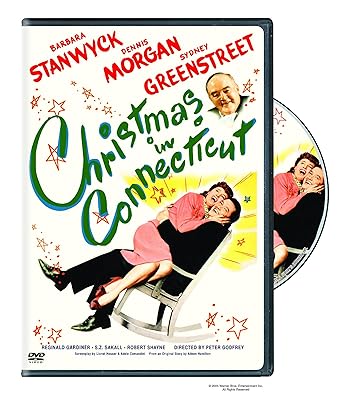
Christmas in Connecticut: Here's another classic that we've recently discovered and enjoy as a family. A woman in post WWII America is desperate to keep her job as a domestic column writer. Her readers think she knows everything about cooking and child-rearing. But she isn't married, has no child, and doesn't cook. It's not a problem until her editor decides to join her for a perfect Christmas. Then the fun begins. This is a comedy that the whole family can enjoy. (And I'm giving away a copy!) 

  • Writing Tip: How can your characters get caught in a web of seemingly white lies? Can they extricate themselves from it? On the romance side, is there a third person to make a love triangle with all the plot opportunities that entails?
So these are a few of the classic Christmas movies that my family loves to watch. I'd love to know which ones are part of your traditions. Is there a favorite holiday go-to movie in your family?
a Rafflecopter giveaway


____________________

Tuesday, November 15, 2016

Writing in the Flurry - NaNo and Not

I have a tendency to get more done when I have less time. Anyone else like that? When forced to produce something, then I am more effecient. Deadlines work for me – challenges work even better.
Of course, I think I've met my match over this past year and a half of being a published author. I'm almost dizzy with the responsibilities of family, work, and writing all combined to have their own deadlines...and many times they meet at the same TIME!
Are you guys feeling the sting? How many of you are participating in NaNo? Does the pressure push your limits?
I haven't participated in NaNo this year because my schedule pushes me aplenty right now. So far for November I've gotten about 15K words in and that's a complete and utter miracle!! But I know many of you are participating. 
What have I realized about fitting in writing time?
1. Daydream often - between work and family responsibilities my writing time is limited, so when I have a few minutes I'll daydream about my stories. As I'm driving from one client to the next, in carline, while cooking dinner...etc. Daydreaming gets my mind and heart ready to put words on a page when I have the opportunity. (I've also discovered the magnificence of using my iPhone to record ideas...YES)
2. TRY to etch out a consistent writing schedule. I'm not great at schedules, but I consistently write for thirty minutes a day. My average is an hour - but that doesn't always happen. I've found that I'm most successful with a consistent time.
3. (FOR ME) Write where the fire is - I get the best wordcount when I'm writing a high-motivation scene, so sometimes if I'm particularly stumped OR if I know I'm not going to get a lot of writing time in for the day, I'll jump ahead to another scene in my book and write it. The scene can be one that has high emotions, lots of dialogue, or one I've already figured out in my head. My word count is higher in less time with these, and I feel more productive.
4. BREATHE - recognize you're human and put your priorities in order. My faith and my kids are the top of my priorities list, but I also need to recognize that my creativeky/heart needs to be a priority too. Recognizing your breaking point is vital to being able to continue writing well and consistently. When you NEED a break, take a short one and then get back in the race. 
5. Chocolate - self-explanatory
What about you? What’s your writing style? What meets your writing needs? Do challenges work for you? Can you skip around in your book as the fire hits? How are your goals for Nano working out for you? Nano-brag if you want!! You can also Nano-cry too - we all get that :-)

Thursday, November 3, 2016

Writerly Inspirations with Beth Vogt


Today I'm delighted to introduce my dear writing friend Beth Vogt to all the Alley Cats. She writes wonderful romance with strong women fiction threads. She also wins awards :-) If you haven't read her yet, consider this your personal invitation. Without further ado, here's Beth!

Beth, can you tell us what's your favorite writer fuel? I’m a tea lover, and my favorite tea is Bigelow’s Constant Comment. I drink it hot in the fall, winter and spring – it snows in the spring in Colorado – and iced in the summer. I also like to snack while I write, so popcorn or gluten-free pretzels. Or grapes. Grapes are always good!

Another thing that fuels me as a writer? Having large blocks of uninterrupted time to write. This is rare, but it’s so, so productive.

I love Constant Comment, too. What's the one thing you wish you had learned early in your writing career? I wish I’d been a more ruthless rewriter. The more books the write, the more I’m willing to tear my books apart to find the best story, the deeper story.

What's your favorite book of all time? Other than the Bible. Ah! I used to have trouble with this question! But then I realized my favorite book of all time is the first book I ever read because that book was the key to all the other books I ever read. So yes, a first-reader is my favorite book – and I relived that joy every time I taught one of my children to read. I just bought a set of Usborne First Readers for my oldest GRANDgirl. (Sssh! It’s a Christmas gift!)

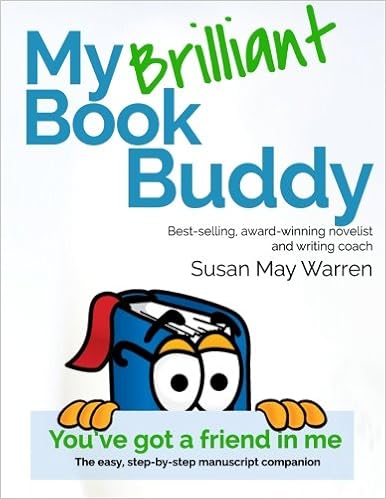
Do you have a favorite writing book? What is it? I use The Book Buddy whenever I start plotting a new book. The Book Buddy is a work-text developed by author Susan May Warren. It helps you develop your characters, your story – the obstacles, the spiritual storyline – all the key elements needed in a novel. When I’m finished working through The Book Buddy, I’m ready to start fast drafting my novel. I love introducing other writers to the book because it’s so helpful to me.


I've used it too, though not all the way through yet. Do you have a favorite writing tool? What is that? I posted two medium-sized white boards on the back of my wooden doors in my office. I’ve used those boards in a variety of ways. Sometimes I use multicolored dry erase markers and brainstorm characters or plot points. Sometimes I use neon Post-It Notes and chart out my storyline. Once I printed out my synopsis and cut it apart – separating each scene – and then used it to post my story outline on the white boards. I referred back to it as I fast drafted and it kept me focused – no wondering “What do I write next?”

What surprised you most while writing this book? I surprised myself when, after turning Almost Like Being in Love into my editor, I called her up two weeks later and suggested a major change to the story. She agreed to the change and so I started rewriting the book. Well, when you change one virtual domino in a story, the others start falling. So, by the time I was finished, I’d rewritten a huge part of the story.

At what point in the book did you hate it? And at what point in the book did you go “oh my gosh I really can write?” I always struggle with my book in the middle of writing it. Most authors do. I start off loving the idea, loving the process, and then I hit the middle and think, “Why am I writing this story? I hate everything about it!” That’s when I FaceTime with my good friend author Rachel Hauck and she reminds me of everything I’ve forgotten. My Story Question. The “why” for my characters. When did I think, “Oh my gosh, I can really write?” When I called up my editor and suggested the change and she agreed with me. I knew she trusted my instincts with the story and that she believed I could pull it off. And when I was done with the rewrite, I knew the story was stronger, better.

Thanks so much for joining us, Beth!

____________________