Showing posts with label author cafe. Show all posts

Friday, February 19, 2016

What Next? – 4 Questions to Ask While Waiting for the Harvest

Hey Alley Pals. I have this super sweet friend. A friend that has stuck closer than a brother. I bet you know her name or at least her books...and if you don't, we'll we're going to fix that today. Please, welcome my dear friend and heart-sister, Kristy Cambron today with one of the most encouraging posts I've had the pleasure of reading recently!


What Next? – 4 Questions to Ask While Waiting for the Harvest

“If we had no winter, the spring would not be so pleasant: if we did not sometimes taste of adversity, prosperity would not be so welcome.”― Anne Bradstreet


We writers spend hours hidden away in coffee shops and bookstores, noses buried in a laptop or journal, putting our story worlds to paper. And for every word we pen, for the hours we spend toiling over each page, there’s probably the same dream burning in the back of our hearts…

The promise of a harvest.

It’s the hope that one day, all the sowing we did during the growing seasons will finally be reaped. We’ll cross into that next phase and become a published author!

I’m tucked away in a hidden corner of a coffee shop most days now because I’m under deadline for my fourth published novel. (It’s such a glorious thing to be able to type that!) But that’s not the way it’s always been. In fact, the lion’s share of my professional writing career – like, fifteen years of it – was spent writing training manuals and technical material for my corporate healthcare job.

That’s a long winter, friends.

A loooong winter to be dreaming of the harvest.

Maybe some of you are in a similar place. You’re writing every day, but you’re starting to wonder what’s taking so long.

If it sounds familiar, then this post is for you, dear writer. I promise– I’ve been there too.
I’ve received the rejections in the mail. I’ve crashed and burned in more contests than I’d dare tell you. After years of working towards the dream, I was ready to quit. But as I look back now, I see the valuable lessons I learned in the years leading up to the harvest.

Each time I felt overwhelmed with agony of the wait, I’d ask myself (4) simple questions to keep going on the journey:


1)     Am I LEARNING?
I entered a writing contest a few years ago and had a dismal showing. In fact, the outcome was so poor, that I stopped writing completely for a month after receiving the judges’ marks. I checked my heart to see if it was still in the right place – if I felt called to keep going. And though my confidence had taken a major hit, I decided to use that break to learn about the craft of writing.

I jumped into some of the mechanics the judges suggested I could improve upon. I focused that time on growth and when I felt ready, I started back at square one with a brand new manuscript. You know what happened? I felt more confident using those skills on a new story than I would have in editing the old one. And the outcome? That manuscript (my eighth, up until then) won the next contest I entered.          

2)     Am I LEANING?

Here’s where sowing into a community of writers now will be worth its weight in gold later.
You’ll find encouragement and support. You’ll share the rough patches and the blissful moments with your writer friends. You’ll pray together and shed a few tears. And through the ups and downs on your path to publication, something magical will happen: you’ll find that the blessing isn’t just in signing a contract – it’s been in the getting there all along!

I cherish the friendships I’ve made with my author friends through the years, and now with my publishing family. It’s a rich part of the harvest I hadn’t expected early on, but came to appreciate down the road.

3)     Am I HAPPY?

This is the big, bad, scary question of them all, because it has the potential to derail everything.
No, we’re not happy when we receive rejections. It’s painful to read judges’ feedback just like it’s difficult to read negative reviews once you’re published. But I continually ask myself as I’m writing: “Am I happy?” Is this time I’m spending creating stories with God adding to or taking away from my joy in Him? Because if it’s not feeding my heart, it’s time to step away. Not forever – just until He gives the go-ahead to take another step and dive back into the dream.

And finally, if those first questions are in check, I’d ask this… the last question:

4)     Am I HOME?

When I walked into my first art history classroom in college, God whispered: “You’re home.”
I knew that while I hadn’t been gifted with hands that could paint or draw, I did have a heart that would sing when it got anywhere near a story like those I saw in the art we studied. And so I began writing. Not because I was getting paid. Not because there was the promise of a harvest years down the road… I wrote because it was (and still is), home.

Where’s your home? Do you remember? Because we can learn the craft of writing and lean in to community for years on the road to publication. We can spend many happy days dreaming of a contract. But unless we’re home when we’re writing – just because there’s no other place we’d rather be–the promise of a harvest won’t fulfill us.

If you’re tucked away in the corner of a coffee shop today, stay there.

Enjoy it.

And one day, when it is your harvest time, remember that you’ve already reaped a sea of blessings on the journey just to get there.

With joy in the harvest,


Kristy

Author Bio:
Kristy Cambron fancies life as a vintage-inspired storyteller. Her debut novel, THE BUTTERFLY AND THE VIOLIN, was named to Library Journal Reviews and RT Reviewers' Choice Awards Best of 2014 lists, and received a 2015 INSPY Awards nomination for best debut novel. Her second novel, A SPARROW IN TEREZIN, was named to Library Journal Reviews Best of 2015 list, and received a nomination for RT Reviewers' Choice Awards Best Inspirational Book of 2015. Kristy's third historical novel, THE RINGMASTER'S WIFE, will release from HarperCollins Christian Publishing in June, 2016.

Kristy is a Speaker and Design Manager at TheGROVEstory.com, and holds a degree in Art History from Indiana University. She lives in Indiana with her husband and three sons, where she can probably be bribed with a coconut mocha latte and a good read. 


You can connect with Kristy at:
Facebook: Kristy Cambron| Twitter: @KCambronAuthor | Instagram: kristycambron

CLICK TO TWEET:


Friday, December 25, 2015

Ten Years and It’s Still True

Casey here: today I am excited to host my sweet friend, Paula Moldenhauer here on our blog with her brand new devotional, Soul Scents: Awaken. And yes, while today is Christmas (and a very, merry one from all of your friends here on the alley!), I did want to share this sweet devotional with you from the heart of a dedicated writer. I hope you enjoy and Merry Christmas!

Purchase here!
What I found was joyously stunning.

Recently I read through hundreds of devotionals I’d written over a span of more than ten years. I was deciding which devotional thoughts I wanted to include my latest book project, Soul Scents ~ A Journey in the Son’s Embrace, which offers four volumes of devotional reading: Awaken, Rooted, Bloom, and Flourish. As I read, made my choices, and edited my heart rejoiced because I still believed it all.

The journey of the last ten years has been arduous, but the glorious truths our sweet Savior taught me along the way stand the test of time.

I may have been naïve in 2004 before the big storms hit. Back then I wrote in wonder as I absorbed new understanding of who Jesus is.  I may not have understood how deeply the concepts I penned would be tested. I certainly didn’t understand what I was praying as I offered my thoughts of praise and surrender, nor did I guess how God would take me at my word.

But I’m delighted to report it’s all true.

I edited word counts and clunky sentences, but the foundational concepts which I so naively typed many years ago needed no revision. And guess what? The devotionals I penned a few weeks ago are again written in wonder as I “absorb new understanding of who Jesus is.”

In 2004 I invited readers to go with me on a journey into the heart of Jesus. I declared we’d never run out of places to discover, and we never have. He shows us glimpses of His character then allows life experiences to solidify the understanding of the insight. Over time He takes initial understanding deeper and reveals new wonders of His Person.

To be vulnerable, our family rode some difficult waters after the earlier devotionals were written. In spring of 2015 I tried to write about the really hard years, but I often dissolved into tears at the computer.

The Lord called me away from those efforts and invited me to spend time with Him. I journaled, did some more Bible study in the Song of Solomon, and rested. Truth be told I spent a lot of time talking to my plants last summer! And the Lord, always the Healer, did what He does best and healed me.
In the fall the Lord released me back into focusing on development of Soul Scents. I wasn’t really surprised (although I was very pleased) when those months of seeking God resulted in devotions for volumes 3 & 4 of this collection. Even though I believed I was not productive last year, I was writing the rest of this series without knowing it.

I love how organic that is.


I’m excited to offer fellow travelers a year’s journey in the Son’s embrace. It begins with volume 1, Soul Scents: Awaken, and continues with a new devotional book releasing each quarter of 2016. 

Author, speaker, and mom of four, Paula Moldenhauer encourages others to be released into full potential through freedom in Christ and the empowerment of God’s grace. Published over 300 times in non-fiction markets, her first devotional book series, Soul Scents, releases in four volumes beginning with Soul Scents: Awaken. Paula’s first two novels released in 2012. Sometimes empty-nesters, Paula and her husband, Jerry, enjoy four adult children and a wonderful son-in-law. Paula loves peppermint ice cream, walking barefoot and talking to her flowers. For inspirational articles, book information, and speaking topics visit: www.paulamoldenhauer.com

Friday, October 30, 2015

3 Tips For Writing Moms To NaNoWriMo With Success:

Today I'm welcoming special guest and brainstormer extraordinaire, Michelle Lim to The Writer's Alley. Wanting to NaNoWriMo with success? Check out her latest tips (AND) enter the giveaway at the bottom of the post!


National Novel Writing Month is almost here and with it comes the challenge to write a novel in a month. That’s a big enough challenge all by itself, but as a Mom, it is even more difficult.

It’s hard to write 2,000-3,000 words a day while you’re chasing toddlers across the playground, shuttling kids to ball games, and attending band concerts. Then there is the whole hour after everyone goes to bed for you to reconnect with your brain cells.

How can I possibly know what it’s like to be at your house? Because I’ve been at my own with three boys and one girl. No matter how great my kids are it is still difficult to get to everything.

My first year doing NaNoWriMoI chased my own schedule at least two hours behind and a load of guilt on my back. It doesn’t have to be that way.

Show your children that you chase your dreams and let them be part of the adventure.

3 Tips For Writing Moms To NaNoWriMo With Success:

This first tip is age universal:

*Enlist the help of family and friends to schedule a writing session for Saturday and possibly Sunday. Make these fun outings to celebrate a month we chase dreams.

Moms realize that the age of children vastly changes what strategies will work, so the following ideas will be age specific.

Ages Birth - 4 years

*Schedule your writing around naptime. Have everything ready to go before you lay your little one down. Do your brain warm-ups and think about what you will write during that last play time before you put your child to bed.

*Plan sensory activities that are highly stimulating for your child while you bullet point some of the basics for your next scenes. Some sensory activities like whipped cream from their high chair, rice and trucks in a bin, or even pudding and wax paper can be fun.

Age: 5 - 11 years

*Card Making or Postcard Creation to send encouraging mail. Either use the postcards for purchase on Amazon (You can even get them in watercolor painting paper). They can do this activity while you write with soft music playing. When the music is finished they can talk to you again.

*Discovery bin with favorites inside. Either get some new things that your child might delight in playing with, or gather toys plenty before so they feel like new. They can only play in this toy bin during your writing time.

Ages: 12-18

*Quiet activity- reading, writing, or other nonelectronic idea that is quiet. Make it 30min-1 hour a day. On the weekend reward its success with a fun activity with Dad (movies, laser tag, etc.).

*Enlist their friends. Rotate an activity to your house another weekend and then enlist your teenagers friends’ parents to take a rotation during NaNoWriMo.

What NaNoWriMo tips do you have?

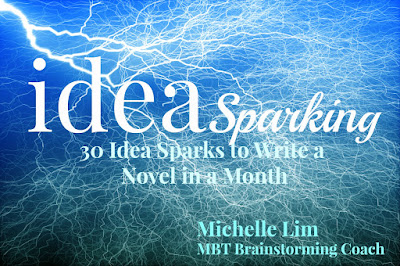
Looking for More Idea Sparking Tips? My New Release is just $0.99 on Amazon.

Idea Sparking: 30 Idea Sparks to Write a Novel in a Month accompanies an author on a thirty-day novel journey. Daily idea prompts assist authors in finding the inspiration to write. With personal experience insights and goal setting reflections, this book is the perfect resource for the writer who wants to write a novel in a month, or the author looking for a resource for their everyday writing journey. What you will find in this incredible resource:

*A weekly inspirational focus to get you ready to write
*Daily Idea Sparks to spark your creativity and get you writing
*Mini writing craft tips that enhance your writing
*Daily Mid-day Milestones with thought-provoking questions to improve writing habits
*Weekly Check-Ups to retune your process to set you up for success

BIO:

Author Michelle Lim is the Brainstorming/Huddle Coach with My Book Therapy Press and the American Christian Fiction Writers. Michelle’s Genesis winning romantic suspense is represented with Books & Such Literary Agency. Michelle’s New Release - Idea Sparking: 30 Idea Sparks to Write a Novel in a Month releases October 27th. Since her nonfiction book release, Idea Sparking: How To Brainstorm Conflict In Your Novel, through public speaking and online chats Michelle helps writers discover the revolutionary power of brainstorming to bring new life to their stories. Connect with Michelle as www.thoughtsonplot.wordpress.com , @MichelleLim24 on Twitter, and Facebook.
Midwest Zone Director for


Join the Idea Sparking Adventure:
   a Rafflecopter giveaway

Friday, June 26, 2015

On Writing and Inspiration. A Guest Post with Rachelle Rea

Recently someone asked me a two-fold question: am I a morning or a late-night person, and how do I stay inspired? Well, then, that's a loaded one. :)

To the first half, neither! On the one hand, I enjoy writing in the mornings because I feel productive; there's nothing quite like living the rest of my day with the knowledge that I wrote a chapter that morning. But I also enjoy writing late at night because I'm trying to keep my eyes open at the same time as my heart is pumping with the excitement of whatever scene I'm in. It's exhilarating.

But I'm neither an early bird or a night owl right now. At this stage in life, I write during my lunch hour at work.

The latter half of the question, though, is even more complicated. Right this very second, I'm inspired. I'm excited to be guest posting on the Writer's Alley, a writing blog I've loved for years. Outside my office window, a thunderstorm is shaking the forest. But, to be honest I'm not always inspired. I know, I know, surprised, right? :)

In answer to that question, I said, I write. Or I don't. Sometimes when a scene idea pops into my head, I write it down right then. In chapter form, on the back of a napkin, or in a note on my new Iphone. I sometimes let it simmer for a while.

Or I don't. Sometimes when I'm not feeling particularly like writing but it's my designated writing time, I tell myself to take a break.

That's right. I tell myself to take a break. To not use that writing time for writing, after all. I don't write.

That's not to say I don't make myself write every time I don't feel inclined to do so. Skipped writing sessions pile up on one another like the raindrops plopping onto the sidewalk outside my office window right now, until suddenly I could be staring at a puddle of a month gone by with no words written. That's not good.

But neither is always forcing myself to produce words, I've found. That may work beautifully for some (I commend you), but I've discovered I'm a healthier person when I realize the artist, the wordsmith, in me needs room to breathe.

Sometimes I don't make myself write on my lunch break. Other times I let myself stay up until 2am to finish writing a chapter just to see how the scene will end. It's like the rain: sometimes the clouds roll in when I least expect them; other times there appears to be a slight drought.

But eventually it rains again, all is drenched, and I'm writing The End again.

When I was in college, I had more of a structured schedule because I knew when classes began and ended. Perhaps one day I will return to that same sort of predictability. For now I'm settling into a world where my novel is on shelves--it's new and exciting. So I write. Or I don't. I'm learning to give myself grace and take a break...

How about you? When during the day do you write? How do you stay inspired? Do you ever give yourself permission to take a break?

Rachelle Rea plots her novels while driving around the little town she's lived in all her life in her dream car, a pick-up truck. An Oreo addict, she is also a homeschool graduate and retired gymnast. She wrote the Sound of Diamonds the summer after her sophomore year of college.

Friday, June 12, 2015

Writing for Love Inspired: An Insider’s View a Guest Post with Keli Gwyn

I'm excited to share with you, one of my very first writing world friends, Keli Gwyn. Keli is one of the sweetest ladies you could ever hope to meet and today she shares her insider view of writing for Love Inspired Historical. Leave a comment below to enter for your chance to win her release (out this month!) Family of Her Dreams. 

The ever-gracious Casey Herringshaw invited me to tell you about my experience writingfor Love Inspired. While I aim to presentthe benefits as well as the challenges, I must warn you that because I’m thrilled to be a Love Inspired Historical author, my bias is apt to show.

Since my debut novel, A Bride Opens Shop in El Dorado, California, was a trade-length book with a CBA publisher and Family of Her Dreams is a mass-market series romance with Harlequin, I’ll be making comparisons. My goal isn’t to advocate one route to publication over another. Both result in getting God-honoring stories in readers’ hands.

Now that we have that out of the way, let’s dive in.

Book Length

A LIH is 70-75K words. My Barbour book was 100K. The shorter length enables me to write more
stories in less time. There are limits, though. I can’t include secondary plot threads as I didin my debut novel. My focus must remain on the hero and heroine.

Some romance readers prefer shorter books. I’ve heard people refer to LI titles as “quick reads” that are just the thing when they want to relax but don’t have a huge block of time.

On a practical note, the smaller size saves money on postage. The boxes of books I buy for inventory and promotion don’t take up as much room in my garage either.

When it comes to entering a LI book in contests, length can be a factor. Some believe LI titles are at a disadvantage if there aren’t categories specifically for series romances, forcing them to compete against longer books. I disagree. A well-told story will rise to the top no matter the length. Case in point: Katy Lee’s LIS, Grave Danger, is a 2015 RITA finalist! Not only did Grave Danger compete with longer stories, but Katy’s book finaled in the Romantic Suspense category along with mainstream titles by well-known authors such as J.D. Robb (aka Nora Roberts)!

Shelf Life

A LI title gets one month in the spotlight. My LIH will hit shelves in select Walmarts and Kmarts around June 2nd and be replaced when the July titles show up.

Because I’ve worn a path to the book section of my local Walmart, I’ve watched many books come and go. Guess what the average stay of a CBA title is?Yup. One month. When the new month’s titles are released, the previous month’s releases are returned to the publishers. A CBA title often stays on the shelves of B&N much longer, though.

When it comes to online booksellers, there’s little difference. Whilethe printed version of aLI titlewill have a limited life, the e-book version of my story will be available for years to come.Since my CBA book went out of print less than a year after its release, it’s possible print copies of my LIH will be available to booksellers longer than my debut novel was.

Editorial Input

I’ve been blessed with excellent editorial input at both houses. At Barbour I dealt with an associate editor, who was quick to answer my questions or forward them to someone who could. A fantastic freelance editor performed theedits on my story. I was able to interactdirectly with her.

At LI my primary point of contact is my awesome editor, Emily Rodmell. She’s available to answer questions I might have about my story, her revision notes, my book’s cover, etc. If I need to talk by phone in order to get clarification on Emily’s editorial feedback, she’ll schedule a call. And does she ever know her stuff! I eagerly await her revision notes and line edits.

Marketing& Promotion

From what I’ve seen, most CBA authors are expected to do a good deal of the promotion of their stories. It’s different when one reaches star status, but little fish like me swimming in a large sea are responsible for doing all we can to help our book make a splash.

LI appreciates anything an author does to help with promotion, but I can’t come close to having Harlequin’s reach. Their name is well known, although I do have to educate my friends unfamiliar with their Love Inspired lines.

Harlequin gets our books out there in a big way. The LI editorial team does a lot to spread the word. My fellow LI authors are great about promoting one another’s books, too, on social media and on two different LI author blogs I’m a member of.

• • •


There’s heaps more I could tell you about writing for LIH and why I’m delighted to be doing so, but I’ve pushed my word count already. Please feel free to ask questions in the comments, and I’ll do my best to answer them.

About Keli...

Award-winning author Keli Gwyn, a native Californian, transports readers to the early days of the
Golden State. She and her husband live in the heart of California’s Gold Country. Her favorite places to visit are her fictional worlds, historical museums and other Gold Rush-era towns. Keli loves hearing from readers and invites you to visit her Victorian-style cyber home at www.keligwyn.com, where you’ll find her contact information


Question for you:

Have you ever thought about writing for Love Inspired? Historical or any of their other lines? Leave
a comment answering the question, along with your email address (U.S. residents only eligible for giveaway) to enter to win Keli's novel Family of  Her Dreams

Friday, May 1, 2015

Five Common Misconceptions about the General Market with Guest Author Kimberly Buckner

I am excited to share this post with you from my friend and fellow Denver resident, Kimberly Buckner. If you haven't heard of Kimberly yet in the writing world, you will someday soon, so mark your calendars with today as the day. She's a fantastic writer with a great viewpoint on writing for the general market. ~Casey


“Oh…”

It’s a common reaction when you tell someone you write romance, right? You can just see them picturing a half-naked Fabio, hair billowing as he rips open some buxom damsel’s bodice. And you want to explain that there’s a lot more to writing romance than Fabio, and that you actually have a story and a message, and that just as God is a creator, you’re being true to your calling when you write these stories of growth, loss, overcoming trials, and of course, love.

I’ve been there. And I get a similar reaction from some friends when I tell them I write for the general market instead of the CBA.

I get it. Not everyone should write for the general market, but it’s where I’m meant to be. To be honest, it took me some time to accept that. My hesitation was in part due to the aforementioned reactions from friends, and in part due to misinformation about what this would look like.  The following are some comments I heard and believed but have since discovered the truth about.


1)     It’s cutthroat and unsupportive.

I went to my first RWA conference last year and was pleasantly surprised to meet wonderful successful authors who went out of their way to help others. I met a fantasy author who offered to read my manuscript. I have chapter-mates who have cheered me every time I’ve had success with a contest. And currently I’m in an email group with 45 other finalists—nine of whom are in my same category—who have become a sisterhood. We root for each other’s success, commiserate over each other’s disappointments, and help each other with query letters and pitches.  The truth is, all romance writers are a sister—and occasionally a brother—hood of people who understand that we’re artists, and the success of one is a success for all of us.

2)     You have to write smut.

Sure, there’s a lot of “edgy” stuff out there now. But there’s also a lot of rich, emotional, wonderful stories that focus not strictly on the physical, but on the beauty and vulnerability of falling in love. And the world needs those books too. I firmly believe that we need to put as much light out there as we can because readers may not know what they’re missing until they find it. We need to demonstrate what real love is and stir a hunger and a motivation to seek that.The difference between Christian publishing and general market is greater than just overt spirituality. Your characters probably won’t have the same worldview as you do. Their language won’t include spiritual references, and no one gets saved. But there’s still room for, and a need for, truth.

3)     It’s much easier to get published.

Yes, it’s a much larger market. But that also means there’s a lot more people trying to write for it. There are five major publishers and they didn’t survive this long by putting out lousy material. They’re still looking for the best of the best.Self-publishing no longer carries the stigma it used to, since there have been a number of highly successful authors who’ve taken that route. But the reason they’re successful is because they’re good. So in the end, story wins no matter what market you’re pursuing.

4)     It’s much harder to get published.

Almost immediately after making the transition I gained more traction than I’d gotten in all my efforts to pursue publishing in the Christian market. I’d found the place I’m supposed to be. And while I don’t think success is always a sign of God’s favor, for me it was the encouragement I needed to forge on. It’s a good fit for me. As a single girl living in the city I know what it’s like out there. Writing about the world as I experience it enables me to relate to my readers. To acknowledge their frustrations, their longings, their expectations, and hopefully to stir in them a desire for something richer than this world’s typical experience.A desire for love that never fails. Plus, my somewhat irreverent sense of humor seems to fit better.

5)     It’s just entertainment instead of a calling.

The truth I’ve come to embrace is that there’s a need in every realm for good literature that points to light and truth.  There are some things that transcend genre that I hope and pray speak through my words to those who need to hear them. The foundations of my faith are still there, still the most vital parts of character growth. Hope. Love. Freedom.

I heard an author I love speaking once, about the power of story. She’d gotten a letter from a woman who left an abusive relationship because the heroes of this writer’s stories gave her hope that better men existed. That moved me.

No matter where we find our place in the writing world, we never know how our stories will be used. But if we put them in the hands of the Creator, we can trust they will.


Kimberly Buckner writes contemporary loves stories set in the South. She is active in ACFW and RWA as a PRO member, and has used what she learned to teach at local chapter meetings and conferences. Kimberly won the 2014 Maggie for Single Title Romance, and the 2015 Emily for Contemporary Long Romance, and is a 2015 RWA® Golden Heart® Finalist for Contemporary. After fourteen fabulous years below the Mason-Dixon, she currently lives in Denver.

She can be found online at:


Friday, February 20, 2015

Becoming an Editor Clients Trust by Paula Moldenhauer

Editing other people’s books wasn’t something I set out to do. In fact, after my first paid editing job I said, “Oh, no! I didn’t want to like this!” But I couldn’t help it. Taking someone else’s raw work and making it shine brought satisfaction.

Perhaps, like me, you’ve discovered a talent for polishing other people’s words. Maybe you’re considering hanging out an editor “shingle” to help support your writing habit. Here are a few tips I’ve learned along the way.

1.       Before accepting or bidding a job, ask for a couple of chapters. It’s a good idea to get the first chapter as well as something from the middle or end. Many authors have a polished first chapter, but as the story or non-fiction book progresses it falls apart.  Browse the chapter and ask yourself questions. Does he have a basic grasp of good writing craft? Does she make a lot of grammar, spelling, or punctuation errors? Do the paragraphs flow in logical sequence? How many awkward sentences do you see? Use questions like these to ascertain a realistic estimate of how much time the project will take you. If the writing needs a lot of work consider billing by the hour instead of the project.

2.       Know yourself. What type of editing are you good at? I tell my clients that I’m great at content editing and line edits, but will not be responsible for proofreading, data checks, or detail oriented feedback.

3.       Have honest discussions with the author. What is the end goal? Some writers want to self-publish; others are honing their craft for traditional publication. Some want a general content edit while most want a line-edit as well. If you intend to also be their proofreader, make that clear. Many clients won’t know there are different stages of editing and proof-reading, so you’ll need to educate them on the process as well as how much each piece will cost them.

4.       If your client is honing craft for traditional publication, he needs to expect professional, deep editing. Talk with her about your plan to edit strong. Ask how much experience he has with critique. Use that to gage your approach. If the writer is not used to feedback, consider a more gentle approach. If she has more experience it’s likely she will better handle your feedback. For either approach use track changes and comment boxes to explain what you are doing and why. It might help to edit one chapter and then dialogue about what you’ve done. Observe your client. How are they handling your suggestions? Resist the urge to rewrite your clients work. Point out what needs to be fixed and leave it to them to fix it. Explain craft issues once or twice. After that highlight them and refer to the comment that explains what the problem is.

5.        If your client plans to self-publish, you need to know their end goals. Some who self-publish want it to read with industry standards. Others just want to tell their story for family or friends. Pay attention to the clients understanding of the industry and ask enough questions to sense their expectations. Dialogue enough to be sure their expectations are realistic.

I had one client who simply had to tell her story. As we talked I learned that she had no further dreams of being a writer. I knew from looking at her manuscript that she had not studied craft, and I had a lot of work to do to make her story flow in a logical manner that would impact her readers. I also sensed that if she saw all the corrections I made she would become overwhelmed and discouraged. We agreed that I wouldn’t edit with track changes. She gave me freedom to rewrite as long as I kept her intent. I also had permission to reorganize her book by sentence, paragraph, or chapter if necessary (I knew it would be). As I worked I made a concentrated effort not to lose her voice as I made my corrections. I contacted her only with sweeping changes. I rewrote her awkward sentences and moved some paragraphs to completely different chapters. The chapters didn’t stay in the same order, either. I put a lot of work into her book because she had a powerful story that would impact lives. In some ways I was more like a co-author whose name wasn’t on the front. I worked harder than the amount of payment we agreed upon, but that was my choice. It was one of those projects where my reward came in her joy in the finished product and the knowledge that the work I did was sure to have eternal impact.

Another editing project I did for a man who was self-publishing had a completely different feel. He was a good writer, but it was his first book. It was quickly apparent he wanted to learn craft and planned to continue writing. The teacher in me was thrilled. I used track changes and line edits and treated him as if he were seeking traditional publication. He wanted his book to be professional and follow industry standards. I took the time to explain to him what I suggested and WHY so he could grow as a writer. As we worked together he began to catch his own craft errors. He needed to see and approve every change. It was HIS baby, and I emphasized to him that I was only the editor. He had the right to reject any of my suggestions.

At first I estimated much less time that I actually needed for the project because his writing seemed clear and concise. However as I got deeper into the project it became clear it needed major restructuring. With his permission I slowed down the line edits to do big-picture thinking. We deleted several chapters and rearranged others. While he gave me a lot of leeway and trust, he also expected to be kept in the loop and had full veto power. In the end we were both thrilled by the final project, and I billed based on a set hourly wage.

6.       No matter who your client is, make a point to point out good writing. A comment noting why something works well or is particularly well down encourages your client. Even a smiley face is enough to help them handle the myriad of suggested improvements.

 
Author, speaker, and mom of four, Paula Moldenhauer has published over 300 times in non-fiction markets. Her first novella, “You’re a Charmer Mr. Grinch,” included in the inspirational romance collection, Postmark Christmas, was a Carol Award finalist, and her first historical novel, Titanic: Legacy of Betrayal, continues to earn five star reviews. Once a public school teacher, Paula loves helping others learn to write. She blogs about writing, motherhood, weight loss, and life at www.abenewjourney.com. For information on her books or speaking topics visit:  www.PaulaMoldenhauer.com.