Friday, March 18, 2016

Tips to Create a Fun, Spark-Filled Romance!

Photo Credit
What does every romance need? A guy and a girl of course! The hope for a silver band by the end of the book and a hunky hero never hurts…no, I would say instead it helps a great deal. ;-)

But what are some great qualities of a good romance?

Sass and spark: let’s just admit that the demure and naïve heroine has gone out with the historical romance novels of yesteryear. Even your typical household, HR books today have a go-getter heroine. Someone who knows what she wants and is going after it. How you go about her “going after it” depends greatly on her circumstances and the era she is living in.

Sass adds for great spice in dialogue. And every character needs that spark on the page. The spark that makes them attractive to not only the hero, but also to the reader so they want to keep reading, because the last thing we want to do is have the reader put the book down.  

Protective and daring: Beth Vogt’s hero Stephen in Somebody Like You plays this part superbly. A 
strong, commanding hero, he is also incredibly gentle and knows how to step into the Haley’s life without making her feel as though he is taking over. Think about yourself as a woman: you want to feel protected and provided for by your man right? How would you want your man to go about doing that for you? Think about those things for your heroine as you are writing the scenes and creating the characters.

Assertive: Your heroine needs to fulfill a need in your hero and your hero needs to fulfill a need in your heroine, otherwise, why should they get together? It needs to be both a physical need—her house needs repairs before it falls around her ears—and a spiritual need—he has never felt truly valued by those he has loved before.

Communication, or lack thereof, does not make for conflict! If the conflict between your hero and heroine can be resolved by them simply talking to each other, you are in need for a few rewrites. The tension has to be stronger than what can be solved by them sitting down in a coffee shop and chatting.
Photo Credit

Put your hero and heroine in compromising situations. Drag your mind out of the gutter, I’m not talking about those kind of compromises. Back your characters into a corner. Send them out hiking and a thunderstorm rolls in: what is their first reaction? Either to the situation or each other? Don’t think along the lines of the perfect response they would make to impress the other, but the gut level I-am-not-thinking-about-what-I’m-saying-or-doing kind of response.

Explore these kind of situations and you’ll learn more about your characters. Are they right for each other? because maybe you’ve created two characters that should never be together.

Have fun with the dialogue—fill it with quips and jabs, fun and humor—it makes the characters come ALIVE on the page and the romance all the more saucy and quick paced.

Indulge in the tender moments and don’t forget to give your hopeless romantic readers a kiss or two to sigh over. ;-)


What is the latest and greatest romance you just finished? We learn from the best!

************************************************
Casey Herringshaw is a homeschool graduate and has been writing since high school. She lives in colorful Colorado where she gets to live her dream stalking--er--visiting with her favorite CO authors. 
.

Thursday, March 17, 2016

Beyond the Sparks in Romance - ~~PLUS BOOK GIVEAWAY!~

When I sat down to write a book all about "love" (because the title was, A Side of Love...) I struggled a little bit.

I mean, I write ROMANCE y'all.

ALL my books are about love, right?

But love is about more than romance.

It's about more than the first flutters of attraction, that heat that swirls in your belly when his hand grazes yours for the first time. The thud of your heart beat when he slips his hand behind your neck and pulls your lips to his.

I've had more than one reader tell me lately that one of the things that discourages them about romance is that it is full of the superficial. Full of the things that make us attracted in the first place but fade when those initial sparks of heat have faded.

Now, I fully believe that those sparks of heat need to be fanned regularly, even in married couples. I say this as a woman who will celebrate her 17th anniversary this year, well past the normal time when the spark dies out. That spark can definitely be reignited with some work on both ends, and can be kept burning. It's not easy, but oh-so-worth it.

But those readers are right.

There is more to love, and really more to romance, than just spark.

I encourage your romance writers out there -- definitely have the spark. But also go deeper. Find out what they are attracted to beside just the passion between them.

In A Side of Love, Garrett gives up his dream job to take care of his elderly mother, moving from the bustling city of Chicago to the small town of Sandwich, IL. That sacrificial love is oh-so-attractive to Beth. It points to his character being one of quality.

So let's chat.

What "deeper than sparks" attraction does your hero/heroine have for each other? Even if you don't have romance, your characters still need a deep character "win" that attracts them to the READER? (and yes, they still need flaws. But flaws without a "win" is, well, probably more like the villain!)

And if you're a reader, what book have you read recently that did a GOOD job of going beyond just the sparks in romance?

AND GUESS WHAT!!!!????


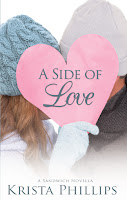
I'm doing a doing a GIVEAWAY today! Everyone who comments gets their choice of a copy of my novel, Sandwich, with a Side of Romance, OR  a copy of my newest novella, A Side of Love.  

These are paperback copies and will come with a special little extra gift with it! 

(Giveaway ends Sunday night 3/20/16, then I'll post winner in the comments and update here!)

*************************************************
Krista is a follower of Jesus, a wife, a mother, and writes romantic comedy. Her latest book A Side of Love, released February 29, 2016.  She blogs about finding JOY in the journey of LIFE at http://www.kristaphillips.com. She is represented by Sarah Freese of Wordserve Literary.


Wednesday, March 16, 2016

Luring Readers Beyond "The End"


Are you interested in having more than one book published? I know I am. So what causes readers to hunt for the author's name instead of searching for great cover art when looking for the next book to buy? Today's discussion provides one intriguing answer. 

There are certain books, movies, and TV shows that have more than a timeless lure. Why is that?  

For today's post, I reached back into TV time to present this masterful writing skill. The screenwriters of the Alfred Hitchcock Presents, Twilight Zone, and the Outer Limits shows, (aired in the 1960's) used a linear direction to pull viewers into the story....

1.Introduced Characters
2.Presented the main character's problem
3.Revealed problems that prevented main character from solving their problem
4.Solve the problem
5.The end 

Sounds familiar, right? This is the same formula we all use for our stories. The difference happens in the next step. Yes. There is "the next step"

When watching one of the shows I mentioned, I am convinced I know the direction the story is heading. I predict what will happen next without even knowing I am doing this. Based on the character's actions the ending has to be.... Isn't this a nice story.

And although I have paid attention to the plot, even searched for the clue that will be the foundation to the ending, and find it, I am so engaged in the storytelling and so convinced of the ending that I am taken by surprise at the last hurrah. Yep every time.

For example- Hitchcock presented a story about a man who had a bothersome wife. He wanted to get rid of her. He dug a hole in the cellar and told his wife he was making a wine cellar. She mentioned to her friends at a party that she was excited about the Christmas present for her husband. He told the friends he and his wife may not return from their dream holiday trip for months. The husband kills his wife and buries her in the foundation for the wine cellar then takes the trip he and his wife planned.

This story moved in a linear way. We meet hubby. See from his view why he is bothered by his wife. Watch him dig the hole and convince his wife this was for a wine cellar. The party happens and they chat with their friends. He kills her, buries her in the hole, then packs for the trip and leaves. End of story? 

Seems like it.

But.

Even with a stellar script and Oscar performances the audience/readers would NOT be inclined to say, I can't wait to read another. The reader wouldn't be upset or dissatisfied...he or she just wouldn't be overly satisfied or eager to find another story by this author. 

The story has intrigue, mystery, suspense. The main character solves his problem. All the components to a great story.

What is it missing? 

The lure. The last hurrah, the moment when I was so engaged I didn't feel the rug being pulled out from under me and left thinking back through the story...and remembering the next day-- found in every episode of the shows I mentioned.

Shall I spoil this little story for you? Yes, I will. The last hurrah for the miserable husband came at the holiday resort where he sat on the sunny veranda. A knock on the door. He answers and is handed an envelope delivered by messenger. The paper inside was a receipt--for services rendered in making a wine cellar in his home's basement paid for by his wife. The Christmas present.

A lure is that little piece beyond the technical ending intended to grab the reader and say, remember this author's name. Buy another book, right now. Yes, get your coat, go online, you must have another story by this author...now.

Does this only apply to mystery/suspense...NO. All it takes is one little line at the end of any genre. Here is an example..do you recall the ending line to Gone With the Wind? Scarlett says it after Rhett leaves. She closes the door and says, "I'll think about that tomorrow." THERE IT IS!!!  The lure.

Consider adding a lure on to the end of your WIP.

To help you think of one, find three lures in stories or movies you already know. The movie Cast Away with Tom Hanks has a wonderful one. Be sure to share in the comment section.


I can't wait to read your comment(s)!

Help others--tweet or FB share this post

 ********************************************************************************************

Rock climbing, white-water rafting, and hiking top Mary's list of great ways to enjoy a day. Such adventures can be found in her stories as well.

Mary writes young adult mystery/suspense, is honing marketing and writing skills, and loves to pen missionary and tell Bible event stories on her ministry blog, God Loves Kids. She has finaled in several writing contests.


Visit Mary at her websiteblog, and her ministry blog to families: God Loves Kids. Or chat on Facebook or Twitter

All subscribers to Mary's newsletter will receive her new short story an intriguing suspense/mystery. Come, read a good story. To get your free gift, sign up for the newsletter at Mary's website or:  Join the adventure!


Tuesday, March 15, 2016

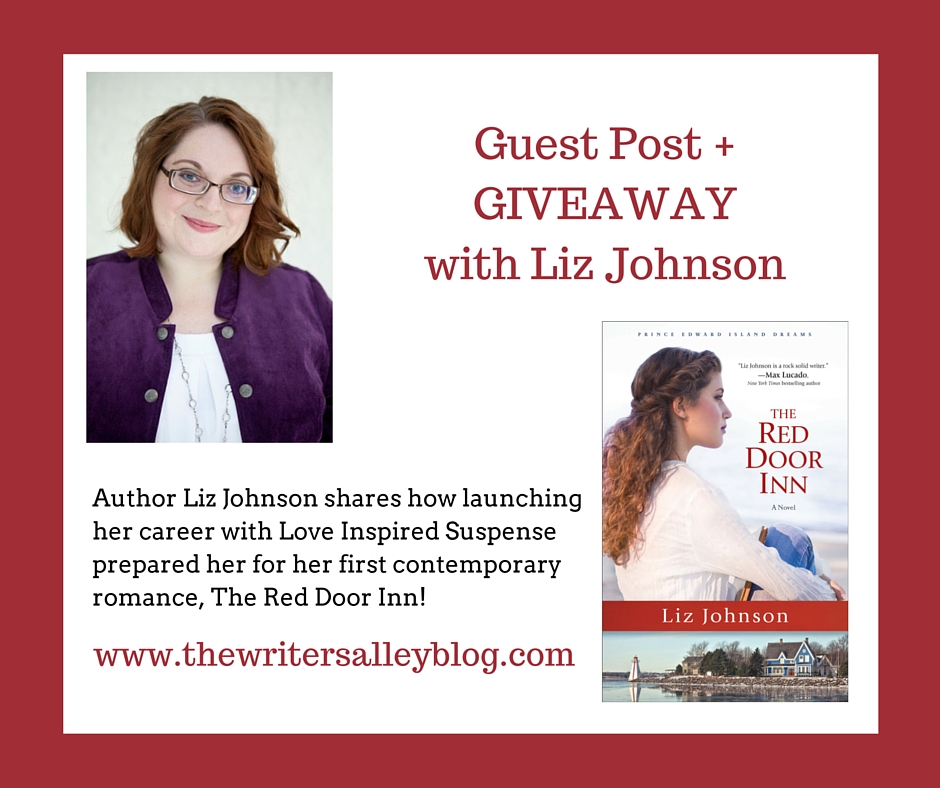
{Guest Post + GIVEAWAY!} Why I Love Writing for Love Inspired Suspense


Laurie here! Today we have a special treat in store -- a guest post from author Liz Johnson! I asked her to share a little bit about how launching her career with Harlequin/Love Inspired helped prepare for the release of her first full-length contemporary romance, The Red Door Inn. Take it away, Liz!


---

When Laurie asked me to share a little bit about my experience writing for Love Inspired Suspense, I did a little happy dance. Okay. It was a pretty big dance. Full arm movements and some sort of jumping-jack action. Quite honestly it was more exercise than I’ve had in a week. (But we won’t go into that.)

How could I not be excited? Love Inspired and its sister lines, Love Inspired Suspense and Love Inspired Historical, have given countless authors their first shot at publication—me included. In fact, my first published novel, The Kidnapping of Kenzie Thorn, was also my editor’s first acquisition. And we’ve been together for the last seven years.

There are so many reasons why I’m thankful to have started my writing career with LIS, but I’ve narrowed it down to my top four. If you haven’t thought about writing for Love Inspired, I’d highly recommend it. Here’s why.

1. They’re willing to take a chance on a first-time, unagented author. I know this because they took a chance on me. My editor plucked me out of the slush pile, and the rest is . . . well, it was a lot of hard work getting my manuscript into shape. She asked me to make revisions. I cringed and slashed pages. And we repeated that three times, until I received THE CALL. I didn’t have an agent. I didn’t have any connection with other LI authors. I wasn’t quite sure what I was doing. But my editor took a chance on me. And LI actively looks for debut authors every year. In fact, they regularly hold amazingly fun contests—like the 2015 From Blurb to Book Contest, which gave entrants an opportunity to pitch their book ideas directly to LI editors then submit proposals and eventually full manuscripts. Last I checked, the Love Inspired editors had signed eight new authors from that contest! (And I do want to add that while I started off without an agent, I’m so glad to have one now. I adore my agent and am grateful for her wealth of knowledge, direction, and industry expertise. (LAURIE: Me, toooo! Not biased at all hehe!) If you’ve already signed with one, you’re leaps and bounds ahead of where I was when I first submitted.)

2. The opportunities are deep and wide. Most publishers put out anywhere from two to four new fiction titles every month. The LI lines put out 16 brand new titles every month. That’s 192 new books a year! The editors are consistently looking for new authors across categories—contemporary romance, historical romance, and romantic suspense. If you write in any of these niches, there might be a spot for you.

3. The editors are top-notch. I feel like I can just leave it at that, but, of course, I’ll expound. First, my editor is always available to me. She offers to brainstorm plot ideas or talk through any questions I might have on her feedback. Second, she always has great ideas. She knows what the LI reader is looking for and how to help my manuscript reach that specific reader. Third, she doesn’t settle for okay. She pushes me and challenges me to write better, to write tighter. Fourth, she fills the page columns with not only editorial notes but also smiley faces. And who doesn’t love to get a smile in the midst of the hard work of editing?

4. It builds a solid foundation for whatever dreams may come. LI has built a brand that its readers have come to depend on. When you read an LI book, you know you’ll get a sweet, short romance with a guaranteed happily ever after. As I writer, I love that structure. And I also recognized when, a few years ago, I had a story idea that wasn’t going to fit into the LI model.

There are certain guidelines for writing LI books, and as I contemplated my new idea, I felt like the embodiment of that old adage. You have to learn the rules before you can break them. (I’m sure my English teacher never said that, but I write by it.) I’d spent years learning the rules of writing a romantic suspense for LIS, and at some point I knew I was ready to break them. And I did with my book The Red Door Inn, my first contemporary romance set on Prince Edward Island. It had a few too many point of view characters, way too many words, and a storyline I knew my LIS editor would question. But I loved the characters, and I couldn’t get them out of my mind. So my agent and I kept working on it together. We received a couple rejections, spent a couple years waiting, and then finally a call. This story that I loved had found a home.

But I had a lot of work ahead of me. The manuscript was done, but that didn’t mean the work was. Thankfully I’d spent years learning how to work with an editor, meet my deadlines, and market my books. These are key skills in today’s publishing market, and I was so grateful to have a firm foundation in them when I was offered a contract on The Red Door Inn. While there’s a learning curve with any new-to-you publishing house, I was much more prepared to take the leap with this book than I would have been without my years writing for LIS.

I love writing for LIS, and I hope to write for them for a long time to come. I’m grateful for the foundation they’ve given me and for the opportunity to explore others stories on my heart.

Have you considered writing for Love Inspired? What’s most appealing to you about them? What has made you hesitate to submit to them in the past? Let us know in the comments for a chance to win a copy of The Red Door Inn!


---


About Liz Johnson: By day, Liz Johnson works as a marketing manager, and she makes time to write late at night. Liz is the author of nine novels—including her latest Love Inspired Suspense, Navy SEAL Security, and her first contemporary romance, The Red Door Inn (Prince Edward Island Dreams, book 1)—and a New York Times bestselling novella. 

She makes her home in Nashville, where she enjoys exploring local music, theater, and making frequent trips to Arizona to dote on her nieces and nephews. She writes stories of true love filled with heart, humor, and happily ever afters. Connect with her at www.LizJohnsonBooks.com or www.Facebook.com/LizJohnsonBooks.


 About The Red Door Inn: Marie Carrington is broke, desperate, and hoping to find sanctuary on Prince Edward Island while decorating a renovated bed-and-breakfast. Seth Sloane moved three thousand miles to help restore his uncle's Victorian B and B--and to forget about the fiancée who broke his heart. He wasn't expecting to have to babysit a woman with a taste for expensive antiques and a bewildering habit of jumping every time he brushes past her.

The only thing Marie and Seth agree on is that getting the Red Door Inn ready to open in just two months will take everything they've got—and they have to find a way to work together. In the process, they may find something infinitely sweeter than they ever imagined on this island of dreams.

Monday, March 14, 2016

Swooning the Austen Heroes, Part 3

Heroes of Austen - Part 3


It's my third and final post about the Heroes of Austen.  Yes, so very sad to say 'goodbye', but you can read posts one and two here (and come back just to look at the pictures :-)


Today, we discuss the two most intriguing Austen heroes (or literary heroes in general) - The Reformed Rogue and the Anti-Hero.
Let's check them out.

The Reformed Rogue

Here we come to the most swoon-worthy of Austen’s heroes, particularlyPride and Prejudice’s, Fitzwilliam Darcy.

- A reformed rogue is a man who begins the story quite flawed and (usually) aloof. His somewhat serious disposition or reserve is one of his attractions.
- The heroine has a distinct desire to change him or find the ‘softness’ underneath the impenetrable expression.
- He is also a character of massive emotional growth, and usually possesses dry wit to go along with his outlook on the world.
- Though many of the other heroes show change from beginning to end, The Reformed Rogue has a clear character arc – from bad boy to good; from hardened heart to soft, from rogue to…redeemed? all because of love.

Mr. Darcy- is Jane Austen’s most recognized hero. He is the tall, dark, and handsome fellow who sends off the wrong (but oh so interesting) vibes in the beginning and then, as he grows and we see more of his real character, he transforms into the amazing hero we love.

Captain Frederick Wentworth would also fit into this category.

 Julie Lessman’s fabulous rogues Cluny (Luke) McGee and Collin McGuire. Whew…

Marc DeHollander from Ruth Logan Herne’s debut Winter’s End

Cassius McLinn from Laura Frantz’s novel The Colonel’s Daughter

John Thornton from North and South

Han Solo from Star Wars

The Anti-Hero


An anti-hero is a protagonist who is as flawed or more flawed than most characters; he is someone who disturbs the reader with his weaknesses yet is sympathetically portrayed, and who magnifies the frailties of humanity.

While an anti-hero cannot slip into a white hat, he will always:

·         have the reader’s sympathies, although sometimes his methods will make this difficult.

·         have easily identified imperfections.

·         be made understandable by the story events, meaning that the reader will come to know his motivations and likely will be privy to his inner demons.

·         have a starring role in the story.

 THIS is the ultimate play boy, the lady’s man, the rebel. He may exude charm or have a certain dark magnetism, but underneath  we discover he can go one of two ways – good or bad, and many times…we’re not quite certain which way that will be. If too the good side, he transforms into a faithful hero. If to the bad? A villain.

John Willoughby - Though I see a little bit of anti-hero in The Reformed Rogue and the Reluctant Hero, Austen portrays the true heart of the Anti-Hero in Sense and Sensibility’s John Willoughby.
- He is the epitome of the Anti-Hero in the fact that we see some true virtues within him, but his self-interests win over his virtue.
- He has a past of poor choices led by selfishness and we get the ‘hint’ that he’s been fairly spoiled throughout his life, but always with the awareness of being a dependent (which can be quite tough on a guy’s self-confidence)
-Unlike Wickham in Pride and Prejudice, Willoughby develops true feelings for Marianne and has every intention to marry her – “had it not been for the money” of which Marianne has almost none.
- John Willougby is essential to the plot of Sense and Sensibility and helps Marianne recognize her ‘perfect’ man isn’t realistic, even if Willougby’s first scene is of him riding forward on a white horse, no less :-)

Some popular Anti-Heroes are:

Artemis Fowl – (my 15 year old thought of this one)

Jay Gatsby from The Great Gatsby

Severus Snape from Harry Potter
Robin Hood
Dirty Harry
Mr. Rochester from Jane Eyre

Have you ever written an Anti-Hero? I bet you can think of a few Reformed Rogues ;-) Hollywood is great at portraying them for the swoon-value. Are you writing one in your novels?

Friday, March 11, 2016

The Paper Kiss...The incredible true story of my last first kiss!

On release day for my debut I got to do some of my favorite things. First, release my first book baby into the world. Second, guest post on the Jaunty Quills Blog for one of my favorite NYT Bestsellers Kristan Higgins. Third, talk about kissing. ((Dreamy Sigh)) And I'm a firm believer no kiss should ever go to waste so I want to share this blog about my LAST FIRST KISS. **(Warning... this post contains red hot smooching!)**


“Two peoples’ lips together, their breath, a little bit of their soul…
A kiss is where the romance is.”

I have to agree with Meg Ryan’s character in one of my all-time favorite movies French Kiss. (If you haven’t seen it, buy or rent immediately!) Now, not all kisses are romantic, but whether in real life or in fiction it’s hard to deny that kisses are powerful things.

Admittedly, a tangible touch someone lays smack dab on your kisser is likely more exciting than reading about two people smooching in a book, though I’d argue to say a paper kiss puts an on-screen kiss to shame any day of the week for the sheer power of your imagination at work, but I digress.
We’re talking about kissing, one of my absolute favorite things to write, read, and shoot, partake in myself. Not all kisses are created equal, certainly. And a first kiss … whether the first ever, or the first with someone in particular, is irrevocably, epically significant—which is why it’s usually the most anticipated moment in a love story.

Those baited breaths, that suspended moment of longing, of doubt. The anticipation strung so tight your chest can barely contain your savage heart. And then… Wham! Lips touch, hearts collide, souls are shaken, and lives are changed. Or they’re not. But what I love about fiction is where that moment takes me. And this is where…

Forget about my first kiss. That was so far from magical it was practically tragic. Since I’m not much for shyness and I’m a die-hard romantic up to my ears in diapers and dirty laundry, let's talk about something swoon-worthy like a life-changing kiss.

If we rewind about ten years, before I married my handsome hunk of a husband and had three of his wonderfully exhausting children, you’d find me tutoring the college baseball player in statistics. This usually took place on campus or at a local coffeehouse. But while I waited for the blockhead to get a clue and ask me out on an actual date, we studied. Talked. Became friends. It was incredibly frustratingly awesome. And then one night we studied at his apartment where his rowdy roommates had us escaping to the quiet of his room whereupon we sat on his bed and actually studied statistics.

Totally romantic.

One would think this would be a convenient place to make his intentions known. But that wasn’t the man I was falling for. This was not an opportunistic moment for him. It was the foundation for a much bigger goal. So at the end of the night, when I was about ready to crawl out of my skin, he took my hand, walked me to my car, and then … asked if he could kiss me good night.

There was something spellbinding about that question. If I were writing the scene I knew I wouldn’t have had the hero ask. In my mind I'd have him be decisive and claim that kiss as if his life depended on the meeting of our lips rather than his show of superhuman restraint in making me grant him access to my pearly whites.

Funny thing about romance, it's not usually what we expect or what we've been programmed by fairy tales to think it should be. And perhaps therein lies the magic of falling. An equation can’t compute it. The variables, well, they vary. Statistics have no bearing. In other words, it’s beyond our control and the result is beautiful chaos.

In that moment, the brain and the jock were standing on the precipice. He’d taken the time to learn me before making his move, instinctively knowing I needed that moment to be something I couldn’t have written or planned or even braced myself for.

But now, I remember…

His endlessly deep voice like the rasp of a rosined bow over my nerve endings. The intensity in his moonlit brown eyes as he made himself vulnerable to me, laying his desire at my feet, surrendering his control. I was hypnotized, barely squeaking out a nod, falling like a wing-less fairy not bothering to reach for her pouch of fairy dust. I was a goner before he laid those gorgeous lips on me. My last first kiss. The cool autumn night a contrast to the cocoon of heat created with the man who was helping me write the most perfect first kissing scene I couldn’t begin to do justice with words.

It changed the course of my life in an instant. And I'm convinced we anxiously await that moment on the page because while it likely differs greatly from our own experience, and it isn’t meant to belittle or replace a perhaps less eloquent reality, what it does is transport us back to that pivotal moment in our story where we had no need for paper because we wrote the memory on our hearts. The paper kiss’s power lies in its ability to flood us with emotions and memories from those first inklings of falling. Of recognizing that shift in your heroine’s journey as if you were walking in her shoes and learning love all over again. That kiss…It’s more than tangled lips and shared breath. It’s nostalgia. That first flicker of promise, the first glimpse of happily ever after. It’s hope for the loved and the lonely alike. And sometimes all it takes is one beautiful kiss to light the way.

Anyone brave enough to kiss and tell? What is it YOU remember about that fateful moment? If you could take your best first kiss and put it on paper, one detail or the whole enchilada, how would it read?

<3 <3 <3 <3 <3 <3 <3 <3 <3 <3 <3 <3 <3 <3 <3 <3 <3 <3 <3 <3 <3 <3 <3 <3 <3 <3 <3 <3 <3 <3 <3 <3 <3 <3 <3 <3 <3 <3 <3

Amy Leigh Simpson writes romantic mysteries with honesty and humor, sweetness and spice, and gritty reality covered by grace. When she’s not stealing moments at naptime to squeeze out a few more adventures in storyland, she’s chasing around two tow-headed miscreants (Ahem)—boys, playing dress up with one sweet princess baby, and being the very blessed wife to the coolest, most swoon-worthy man alive. Amy is a Midwestern-girl, a singer, blogger, runner, coffee-addict, and foodie. Her Sports Medicine degree is wasted patching up daily boo boo’s, but whatever is left usually finds its way onto the page with fluttering hearts, blood and guts, and scars that lead to happily ever after.

Check out her debut romantic mystery novel WHEN FALL FADES available now for $3.99!

Thursday, March 10, 2016

Mastering Your Own Story


You know that novel that hooked you from the first page, that you settled into like a fancy-but-comfy pair of Kate Spade's, and that you keep on your shelf to read and reread? Maybe it's the novel that began your own dreams of writing. Maybe it shaped your perception of story when you were a kid.

I think we all set out to write that novel, in one way or another, don't we? No one says, "Yeah, I'd be perfectly satisfied to write a just mediocre story with just mediocre sales and a just mediocre impact on my readers."

Photo by Just2Shutter at freedigitalphotos.net
And yet, I have to ask you-- is mediocre exactly what you're settling for in your writing?

Frank Peretti once told me he takes two years working on a book. I heard Jocelyn Jackson speak, and she said she has characters in her mind for years before they hit the page. And Robin Jones Gunn's Christy Miller Series was rejection ten times before it went on to sell millions of copies. She just needed some help from her youth group girls first. Is it a coincidence that great writers spend a lot of time and many drafts on their work? Or are they great writers because they do?

No one wants to wait five, ten, or fifteen years for publication. I mean, let's be honest. But what if it takes five, ten, or fifteen years to write your story the way it ought to be told? Are you willing to do that, or will you settle for mediocre?

Lately, I've been thinking about what makes a "whoa!" book different from a "meh" one. And I think a lot has to do with mastering your own story.

I just started reading my friend Liz Johnson's The Red Door Inn, and I'm amazed by how well she tells this story. Another book that gave me a similar reaction was Kristy Cambron's The Butterfly and The Violin. Know why these stand out to me as a reader? I trust every element of the way the story is told.

Let me explain.

We as writers must be the masters of our own stories. We spend so much time studying plot, dialogue, characterization, pacing, and genre expectations-- and for good reason. But we can't forget that behind all the lessons on craft, even the most well-formed story is lacking if it doesn't show magic. And magic comes from the storyworld.

So how can we become masters of our own stories?


  • Time. Don't rush your manuscript. You can not have mastery of your story if you don't have deep and intimate understanding of all its elements, from the characters' struggles and lessons to the over-arching take-away. That often just takes time.
  • Many, many drafts. I always tell my students that if their essays aren't up to par yet, it's probably because they haven't yet written enough drafts. Don't get discouraged by comparing your work-in-progress to someone else's fifteenth draft. And whatever you do, don't assume "famous" authors write like that in their first drafts. Many of them just discipline themselves to continue writing/editing until the story gets up to their standards. 
  • Metaphor in story world. Nothing should happen in your story by accident-- not the place where the heroine lives, or the hero's job, or his favorite thing to eat. What is the theme of your story? Brokenness? Then maybe the heroine's car should break down frequently, inhibiting her ability to get where she "needs to go," literally and figuratively. Does your hero miss his grandfather? Then maybe he always wears his grandfather's old jacket, and when the heroine spills coffee on it, well...

Remember that the only person who can tell your story is... well, you. So don't get caught up in rushing the process. If readers can trust that you've controlled every element, they will sense a depth in your story world that will pull them in all the more. And let's face it-- those stories are so much more fun to write!

What books stand out to you as masterfully told? What can we learn from them?


###


Ashley Clark writes romance with southern grace. She's dreamed of being a writer ever since the thumbprint-cookie-days of library story hour. Ashley has an M.A. in English and enjoys teaching literature courses at her local university. She's an active member of ACFW and runs their newcomer's loop. When she's not writing, Ashley's usually busy rescuing stray animals and finding charming new towns. You can find Ashley on her personal blog, Facebook, Pinterest, and Twitter. She is represented by Karen Solem.