Showing posts with label les mis. Show all posts

Tuesday, April 2, 2013

Setting and Spiritual Thread

Setting and faith. The two are inexorably intwined in literature and movies. 

The English countryside. Stark, spacious. At the beginning of The Lion, The Witch and the Wardrobe Mrs. Pevensie puts her four children on a train. The time period is the second World War and the nightly air raids in London lead the children's mother to the decision that they will go and live with their relatives in the countryside. So they go join their eccentric professor uncle. The setting is stark. The countryside sounds beautiful, the castle large and looming, dark and overwhelming. The children are often bored and find themselves spending time in useless pursuits. The brief scene in London could certainly foreshadow the future spiritual warfare battles the Pevensie children will face against the White Witch and the evil forces of Narnia. Yet the house in the countryside itself provides a different type of spiritual battle. The children face the forces of boredom and laziness, the sources of many a temptation. At their wit's end, fights between family members are frequent. 

Suddenly an ordinary wardrobe full of coats is transformed into something magnificent. We've been established in the Pevensies world, now we move to a new location. The spiritual landscape of Narnia is immediately established as a different type of setting. The lantern Lucy sees when she stumbles through the back of the wardrobe is a symbol of the light found in Narnia. The landscape itself is beautiful, covered with luscious forests and deep lakes. The sense of color is a quick contrast to the grays and dark greens of the countryside house. Narnia is a magical place. We see the setting and we are immediately transfixed. Though many battles will take place in Narnia, we also see a clear source of light. The landscape itself is involved in a spiritual battle, because of the White Witches presence Narnia and the lands surrounding it are in a long-lasting winter season. The ice on the trees, the snowy mountaincaps are all intensely beautiful. Here we see that evil can appear beautiful on the surface.

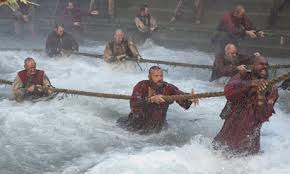
One of my favorite recent movies is Les Miserables. A few months ago I discussed developing a more believable villain using Javert in the 1998 version. The setting itself in many places is part of the spiritual thread that holds the movie together. This time I am focusing specifically on the 2012 version. The movie begins with a camera focusing in on a large ship. The colors are stark and the sea is raging. Within thirty seconds, the viewer understands that this is a place of great spiritual and emotional darkness. Javert stands against the landscape, nightstick in hand, like a sentinel guarding the prisoners as they lift the ship and drag it to shore. A mere few minutes later, main character ValJean is dismissed. His parole has begun, not to be confused with his freedom. As ValJean begins the long walk to visit the police department for his papers, the camera shows a more wide-angle view. The world is more vast, but as he ascends gray rocks, his world is still shown through a dark lens. He has not yet achieved freedom. 
The first glimpse of beauty we see in the setting of the movie is a chapel ValJean enters after his encounter with a local priest. ValJean returns to his default setting of stealing and takes some silver, but is offered tremendous mercy by the priest who asks why he didn't take the candlesticks as well. During their exchange, he tells ValJean, he must become a changed man. The first beautiful place we see is the chapel he sits in, repenting of his former life and vowing to become a new man. There are many scenes here that take place in a chapel and the Cross on the wall becomes a beautiful symbol of meaning. We see the stained-windows of the church here and watch in glorious triumph as Jean ValJean exits the church, ripping up his parole papers which demonstrate his "old man." There is a beauty as we watch these papers falling in the wind, a place that was ordinary becomes a setting of freedom. 

My first work-in-progress takes place in a compound-like setting in the countryside in Utah This community may not have a physical border provided by fences, but there is a natural border provided by a dense forest on the edge of the town. Those who cross these borders are punished and further face the threat of "eternal judgement" from the elders. The houses are close together, it isn't hard for your neighbor to know your business or to "tattle" on you to the church board. The small luxury of beauty is provided by a garden in my main character Rachel's yard. The houses look very similar in style on the outside and there is little variation in decor on the inside. Isolated and depressed, the setting reflects Rachel's spiritual state. She lives by the rules created by the Prophet missing the freedom of life in Christ.

Whether its the peaceful quiet of the nunnery in Paris ValJean and his daughter escape into or the stark moors of  England in Jane Eyre setting is linked with the spiritual thread of story. Paying heed to the type of spiritual atmosphere you want to form will help you in creating your setting, whether a real or imagined place.

Do you have a favorite book in which the setting and the spiritual arc play off each other? How about in your own novel? 


Julia enjoys writing women's fiction whenever she can find a chair free of smushed peanut butter sandwiches and lego blocks. She is a wife and homeschooling mama of two littles. She also enjoys reading and reviewing books for Library Journal, The Title Trakk, and Christian Library Journal.

Tuesday, January 22, 2013

"Where Will You Go? I'll Find You": What Les Mis Taught Me about Creating Believable Antagonists

Have you ever read a book where the antagonist appears to have been clipped out of the Sunday cartoon pages?

It can be a challenge to create a believable villain.

One that has dreams and fears. Compelling backstory shared in small tidbits. True-to-life dialogue makes this character a man you love to hate.

My favorite literary antagonist? Inspector Javert.

Read on to find out why and what he taught me about the heinous art of villainy.

Let's begin at the end (this short scene may contain spoilers if you haven't seen any film version of Les Miserables).


Javert: I'm glad I had time to myself. I needed to think... about what you deserve. You're a difficult problem. Move to the edge.
Valjean: Why aren't you taking me in?
Javert: You're my prisoner. Do what I tell you! You don't understand the importance of the law. I've given you an order. Obey it. Why didn't you kill me?
Valjean: I don't have the right to kill you.
Javert: But you hate me.
Valjean: I don't hate you. I don't feel anything.
Javert: You don't want to go back to the quarries, do you? Then for once we agree. I'm going to spare you from a life in prison, Jean Valjean. It's a pity the rules don't allow me to be merciful. (He frees Valjean from the handcuffs) I've tried to live my life without breaking a single rule. You're free.

 This is the compelling end of the 1998 film version of Les Miserables. Although there are many film versions and the recent musical version is emotionally compelling and visually spectacular, Geoffrey Rush is my favorite in the role of Javert.

I quoted from the last scene of the movie, because it provides a number of insights into Javert's character that are demonstrated throughout the novel. The importance of the law and keeping justice are motivating elements in Javert's life, shown clearly in this scene.

"I need to think about what you deserve." How does your antagonist put his world together? Justice is the main lens through which Javert sees his world, therefore whether a character receives fair treatment is important to him. What is the motivating force that drives your antagonist? How might this cause his hatred of your protagonist? How does this influence what he thinks of your main character and how he might react to him or her?

"You're a difficult problem." Your protagonist views your antagonist as a problem to be solved, but don't forget your antagonist views your protagonist the same way. Look through his eyes for a few minutes. What  types of specific problems does your protagonist create for your antagonist? How does that further his fuel in opposing your hero/heroine?

There, out in the darkness
A fugitive running
Fallen from God
Fallen from grace
God be my witness
I never shall yield
Till we come face to face

This is the first verse of "Stars", a theme song for Javert in the 2012 musical (and previous Broadway versions). My favorite version is sung by Philip Quast in the London production.

Val Jean has thwarted Javert at every turn since he evaded his parole many years earlier. Javert's worldview does not allow for redemption. Javert views it as his God-given purpose to capture those who have disobeyed the law. He exacts the same harsh standards on himself as he does on others. Javert's lie is that character change is not possible. Just as Javert cannot change his past, he also believes he and others cannot change their future. Valjean stole a loaf of bread to feed his family, his identity is forever as a thief.

What is your antagonist's lie? How does it affect how he interacts with your protagonist?


"You're my prisoner. Do what I tell you! You don't understand the importance of the law. I've given you an order. Obey it. Why didn't you kill me?"

Life should be well-ordered. The law gives Javert's life meaning. His mother was a prostitute, his father a thief. Javert was born in a jail cell. He will do everything he can to make sure he does not become like his parents. When he strikes out at a prostitute, in some sense, he is trying to bring order to his disorderly past. 

Javert is flabbergasted that Valjean didn't take the opportunity to kill him in a back alley chase. He doesn't understand the changes in Valjean, who promised his soul to God when a priest forgave him for stealing precious candlesticks. Valjean's decisions are now based on mercy, not justice. Javert does not comprehend Valjean's new worldview.

What does your main character do that puzzles your antagonist? Disturbs his/her worldview? 

Javert: But you hate me.
Valjean: I don't hate you. I don't feel anything.

As Christian writers, forgiveness is a main theme in many of our novels. Our salvation itself is based on Christ's forgiveness of our sins. And we are called to forgive those he has placed in our path.

In Him we have redemption through His blood, the forgiveness of our trespasses, according to the riches of His grace. (Ephesians 1:7, NASB)

Then Peter came and said to Him, "Lord, how often shall my brother sin against me and I forgive him? Up to seven times?" Jesus said to him, "I do not say to you, up to seven times, but up to seventy times seven. (Matthew 18:21-22, NASB)

Javert cannot comprehend the mercy of Valjean. Valjean has a chance to kill Javert, but doesn't take it. Valjean doesn't hate Javert, he pities him.

How can your main character show grace and mercy to your antagonist?


Do you have a favorite antagonist in a book or movie? What villain do you love to hate...and why? 

What techniques do you use to create a strong antagonist in your own work?


 Julia enjoys writing women's fiction whenever she can find a chair free of smushed peanut butter sandwiches and lego blocks. She is a wife and homeschooling mama of two littles. She also a reviewer for Library Journal, Christian Library Journal, and Title Trakk.