Thursday, July 9, 2015

Why You Shouldn't Be A Writer

We can all spout out the reasons we write. Using our talents for God. Because we have an insane love of story. Because you can't NOT write. The list is, I'm sure, endless.

But this writing life isn't always pretty, so I thought it'd be fun to name some reasons NOT to be a writer. 

The money is crap. A very large majority of authors are nodding emphatically. Now, what we WON'T tell you is that we still have little dream that we've stuffed away in a secret place that we don't mention to most people.... that dream of a Castle-like paycheck. But yeah.

A lot of people will tell you that your talent is crap. Critique groups, contests, agents, editors and then finally, readers. And getting it from readers is the worst. That 1 star review from a person who hates your book and doesn't understand how it ever got published... it isn't for the faint of heart.

Sleep is never guaranteed. Characters tend to talk at many different times, sometimes super early in the morning and for others, until wee hours of the morning. If losing sleep is an issue, writing might not be for you!

The impatient need not apply. A career as a writer has a LOT of "wait" time built in. Waiting for emails from agents and editors, waiting for that contract, many times for years and years. Even an indie author has some essense of waiting-- waiting for edits, waiting for a book to appear online, waiting on cover art, waiting for sales to gain traction. If you like things NOW and aren't willing to bend on that... you might want to pick a different job! (or get ready to learn some patience!!)


A sign of someone who SHOULD be a writer is one who reads a list like this and instead of getting discouraged, smiles at the challenge to overcome. Who says, "I know all that" and continues on the journey anyway.

Early on in my writing journey, all of these truths were glaring and the forewarning from other writers was loud and clear.

But I'm so thankful for those warnings. Because they made me work that much harder, because a sure fire way to get me to do something is to tell me I can't.

Do you have any "reasons not to be a writer" to add to my list? Do you get discouraged when you think about the reality?

*************************************************
Krista is a follower of Jesus, a wife, a mother, and author of Sandwich, With a Side of Romance, A Side of Faith and A Side of Hope. She blogs about finding JOY in the journey of LIFE at http://www.kristaphillips.com. She is represented by Sarah Freese of Wordserve Literary.

Wednesday, July 8, 2015

The Terrifying Benefits of Public Speaking for Writers


Public speaking is one of the best marketing tools available to writers. 


However...


Public speaking seems downright scary. 


There are a token few authors/writers who can stand in front of an audience and wax eloquently about a given topic while engaging listeners for say thirty minutes without sweating. The rest of us prefer to hide in our caves or hover in introvert cliques.

BUT, public speaking still is one of the best marketing tools available to writers. Way better than posts on Facebook, Twitter, Instagram, etc., which entice readers for a only a brief moment. 


Speaking to an audience:

1. Offers a setting where the listener can be fully engaged in your message.

2. Provides an avenue for people to meet you personally.

3. Give listeners a chance to ask you questions and hear your immediate feedback. 

4. Helps listeners understand you are interested in them by use of eye contact, hand shakes, responding to their greetings and comments, and willingness to speak face to face.

5. You can sell your books afterwards or for those of us who are not published yet, we can have a flyer about our current WIP to hand out.


So how can we convince ourselves to peel off the scary and take advantage of these benefits? The key is total preparation and a bucketload of gumption. 


1. Choose three topics you could talk about. The material does not need to be about writing. What do you really like to do? 

*Is there a craft you enjoy? (scrapbooking, quilting, cooking, woodworking, gardening, etc.)
*What is the theme in your current WIP? (homeless, marriage, dating, abortion, traveling, genealogies, etc)
*What is something you would like to learn? (more about the writing craft, how to play an instrument, how to set up a neighborhood Bible study, how to host a book club, how to ski, how to hike safely, how to plan menus for special diets, time management, etc)

2. Write an outline of the main points you would like to share. Research, making sure to have a list of resources for the curious listeners. Write the exact words of your presentation, bolding key points (Did you know our pastors have their sermon printed out word for word? Of course they deviate when needed, but it is there for them if needed). 

3. Read the script you just wrote out loud and time it. Does the script need to be longer? Shorter?

4. Practice in front of family members. Did you feel nervous? Good. Was your talk longer or shorter as a result? This is great information. Adjust the script to fit the thirty minute time.

5. Make a list of places you could present any of your three scripts. Some presentations are best for specific audiences, (for example a library, an elementary school, junior high, high school or college, ladies Bible study, church gathering, community gathering, girl/boy scouts, 4H, craft clubs, etc.) 

Be open minded. With a little tweaking, the same presentation could be given to a ladies group or an elementary school group. Prepare the tweaked version ahead of time. You never know when someone might invite you to speak.

6. Design a simple advertisement. This can be a post card, flyer, etc. Include basic information about you as a writer. List all your available topics to present along with a brief summary for each. Include contact information. Send to the organizations. Post them in libraries, coffee shops, and other community bulletin boards.

Recommendation-do not charge until you have some experience. The purpose of these opportunities is to get your presence (not just name) out there.

7. Take every opportunity offered. Even if you think five-year olds won't listen to a presentation about quilting, or a teen group won't listen to a talk about writing, or a senior group won't be interested in dating, you might be really surprised. AND each listener has friends and family who could be interested in your next published book!

The last piece of advice: kick yourself out the door and go. Stand strong. Ask God to calm your jitters. Your listeners will not bring apples or shotguns. ;)


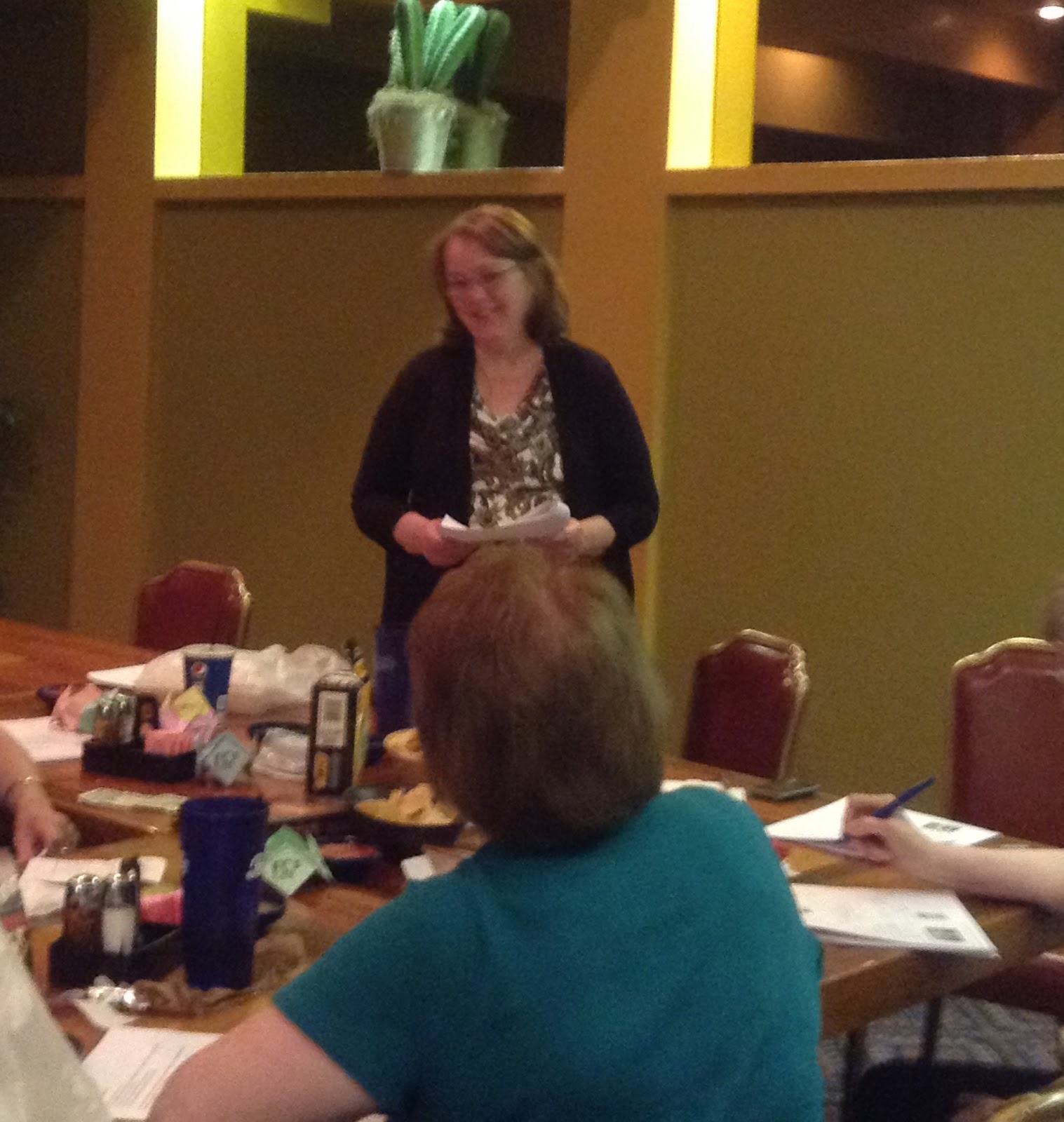
When you try - amazing things happen. I know! I spoke at the Great Lakes ACFW group meeting, June 2014. They gave me an honorarium and paid for my lunch. What meant more to me, though, was the tremendous feedback and the successful opportunity to get my presence out there. 

"After fifteen years of writing and knocking on publishing house doors finally relying on self-publication to get my work out there, I found Mary’s insights about pre-publication work not only valuable but essential knowledge that I lacked.  Her interactive presentation was not condescending, which produced incentives for further goal setting and hope for the future."


And guess what--you can do it, too!

I know there is so much more to say on this topic - like handouts, etc, maybe another time.

What concerns do you have about becoming a speaker?


I can't wait to read your comment!


*******************************************************************************************************

If you found any typos in today's post...sorry about that. 

Mary has moved to Michigan with her husband, closer to her three college kids. She misses the mountains of Montana, but loves seeing family more often. She writes young adult mystery/adventure Christian fiction, is honing marketing and writing skills, and loves to pen missionary and Bible adventure stories on her ministry blog, God Loves Kids.

Visit Mary at her website and her ministry blog to families: God Loves Kids. Or chat on Facebook or Twitter

Tuesday, July 7, 2015

Beauty from Brokenness: The Glorious Dichotomy


Today I went to the funeral of a 20-day-old baby, the firstborn son of some dear friends of ours. It was a hard, but beautiful day. This couple has been so faith-filled and authentic about their roller coaster journey from battling fiercely in prayer for his life to wrestling with God after his death. Praising Him endlessly.


But as their loved ones gathered to say goodbye, my friends led them in worship, using their gifts to serve and give God glory even in the face of crushing grief. The theme of the afternoon was that, even though no parents should have to lose a child, even though we don’t understand why it happened, God is still good. That’s constant, along with the fact that He’s always with us.


The baby’s brave and beautiful mother shared something that stuck with me, something I wanted to share. Because, I promise, it has everything to do with writing.


In a raw and poignant piece she wrote after her son’s death, “Where I Found God,” she talked about how she’s experienced God when everything in life was going according to plan and, now, when the ground disintegrated beneath her feet.


Our God didn’t change due to her circumstances, she said: He is constant. He always remains the same.


And she pointed out that we don’t have to wait to approach Him in our proverbial Sunday finest, with a pristine face, when it’s easiest to remember to praise Him. We can come to Him messy, broken, raw, speechless. Angry, even. We can ask Him questions and wrestle with Him when faith is living up to its definition, heavy on the “not knowing” aspect.


I think it’s important to capture this in our writing. To give our characters real problems where they begin to lose hope. Where they’re hanging by a thread. It’s important to show how they learn a full reliance on God and His strength, even if it takes them a bit to get to that point.


I think it’s important to show that the end doesn’t always turn out the way we imagined it would be, but it can still be beautiful.


But I think it’s our duty as writers to emphasize the beauty rising from the brokenness. God’s power being made perfect in weakness. That He will scale even the steepest of slopes to redeem a situation and then carry you on His back the whole way home.


Today, I was privileged to witness that dichotomy. The powerful worship of broken, grieving people held together by hope. The place where darkness couldn’t extinguish the light.


And in real life, in fiction, whatever, there’s nothing else that points people to Christ quite like it.

---


Laurie Tomlinson is a wife and mom from Tulsa, Oklahoma, who is passionate about intentional living, all things color-coded, and stories of grace in the beautiful mess. Previously a full-time book publicist, she owns a freelance copywriting, editing, and PR consulting business. 

She's a member of the American Christian Fiction Writers and received the Genesis Award in 2013 (Contemporary) and 2014 (Romance). 

Her work is represented by Rachel Kent of Books & Such Literary.

You can connect with Laurie here:
Twitter - @LaurieTomlinson


Monday, July 6, 2015

The Saggy Middle Diet


pixabay.com
Did that title get your attention? If you’re trying to shed a few pounds like I am, it might have J For the past two weeks I’ve been carefully following an eating plan in the hopes of detoxing my carb-loving, sugar-adoring, fat-storing body. I enjoy eating…for the simple joy of eating, and after a few years, and a few kids, it’s taking its eternal toil on me, so I’m trying to reduce my saggy middle.

It’s hard work, filled with strategic planning and purposeful eating.

Progress is SLLLLOOOOWWWW, but I hope the reward at the end will be worth the slogging.

Get where I’m headed?

One of the dreaded parts of novel writing or reading is getting to a saggy middle of the story. Sometimes it can seem sluggish and slow, other times it can feel really drawn, and there are even times when it might have lots of action…but its only action for action’s sake – it doesn’t move the story forward.

I’m writing the middle of my WIP right now and I’m trying to brainstorm ways to make the middle as powerful as the beginning and end.

Finding that ‘finely toned’ middle can be a lot of hard work, filled with strategic planning and purposeful writing.

I’ve tried to think of 5 ways to help support toning up the flabby middle of your novel.

1.       Spice Things Up – adding action or emotional intensity is a great way to spice up the center of the story. Mary Connealy once mentioned something about ‘when things get slow, bring in a man with a gun.’ J For her and Amy Leigh Simpson’s books, that would work….not so much for other types. The point is, if you can keep the intensity high (as you hope to do within each chapter), it will help keep the pacing of the story moving. 

This is usually helpful when you have some subplots going on.

It’s also a great place to reinforce your character arc by bringing in some good scenes to support or challenge the direction you want your character to go.
 
I’ve added a subplot which has really intensified the middle but also undergirds my heroine’s bigger story question.

 2.       Make Your Moments Count – but within the ‘spice’ your scenes need to be purposeful, helping spurn the story forward. A meaningless middle, even if action-packed, can still feel just as empty as the saggy middle. Every chapter, beginning, middle, or end, should help lead to the ultimate goal of your novel. Don’t just throw a smoking gun into the mix unless it’s going to help move your main story forward, either through character self-awareness or other-awareness.

 Just like on a diet, you’re keeping that bigger goal in mind as you make little decisions.

 3.       If You Get Off Track, Jump Back On  - High pressure is a notorious killer of creativity. Believe me, right now I totally get it! Having the pressure to get words on the page can instigate a whole host of insecurities and worries that can really kick in the writer’s block. An important thing to remember, is if you get stuck (or eat that delicious banana pudding on the 4th), you can keep writing. So what if you have to delete the scene? Writing spurs on more writing. Other options might be taking a walk, watching a movie that will inspire your story creating, brainstorming with friends, or listening to beautiful music.

 I’ve been watching episodes of Downton Abbey, biographies about World War 1, and some other era-based movies to help when I’m stuck.

 4.       Keep Your Goal in Mind – You started this book with a purpose. As we discover our characters and story writing, we hope that initial purpose becomes clearer and clearer. As you enter the middle of your book, remember why you were drawn to this story-seed. What about the characters captured your heart to lead you into story-creating? Keeping the goal in mind will help you tone up the middle.

 
What about you? What are some tools you use to tighten your saggy story middle? What are some books you’ve read where you’ve enjoyed the story all the way to the end…even in the middle?
 
**********************************************************************
 
Pepper Basham is an award-winning author who writes romance peppered with grace and humor. She’s a native of the Blue Ridge Mountains, a mom of five, a speech-language pathologist, and a lover of chocolate. She enjoys sprinkling her native Appalachian culture into her fiction whenever she can. She currently resides in the lovely mountains of Asheville, NC where she works with kids with special needs, searches for unique hats, and plots new ways to annoy her wonderful friends at her writing blog, The Writer’s Alley. She is represented by Julie Gwinn and her debut novel, The Thorn Bearer, released in April 2015. You can connect with Pepper on her website at www.pepperdbasham.com, Facebook-  https://www.facebook.com/pages/Pepper-D-Basham or Twitter at https://twitter.com/pepperbasham


Friday, July 3, 2015

Don't Stop 'Til You Get Enough

 
This right here was one of my very first blog posts when I started writing over four years ago! Put a big smile on my face! I've come a long way, but I can still relate.

What about you?
November 2011

Oh, the bane, the bear, the brutality of the relentless self-editing.

Perfectly adequate sleeping hours are waving as they pass me by. The threat of yet another late night feeding from my little Rafey forebodes with each fleeting hour. And yet I convince myself that this is THE FINAL READ THROUGH. “You are almost there,” I chant in my head, providing my own personal pep squad—and no, I was not a cheerleader. Speaking aloud while my hubby sleeps nearby is a sure fire way to get booted from the comforts of my bed. I get enough grief from the supposed “jack hammering” of my fingers on the keys and the soft glow of the screen as it is. But honestly, the man can fall asleep sitting up on the couch with every light in the house on, and the TV roaring at absurd decibels. Men are peculiar creatures.

So here goes the final edit, the final read through, until page 3. How on earth have I read that sentence fifty-five times and still never noticed that for is supposed to be from? And why is she smiling so much, there is a dead body in this scene?

For those of you with irritating perfectionistic tendencies like me, the vastness of 90K+ words proves to be a daunting task to comb through. And as my self-prescribed deadlines come and go, I wonder if I will ever bite the bullet, pry the electronic, and thus metaphorical, pages from my white knuckled grip and lay it all on the line.

Okay, so maybe I am a baby writer. And some glorious day, I will know exactly what my editor will look for, my observations and insights into my own work will become super-keen and second-nature, but what about now? How much editing is enough?

And if I keep going, past the point of sanity, will I edit the life out of the pages? Is there such a thing as too much?

Now, obviously, editing is a good thing. My first novel, Beauty for Ashes, barely resembles the original text I pounded out in six short weeks. Thank goodness! We have all seen the amazing fruits of our labors when it comes to editing, shaping the story, adding the detail that really puts the reader in the moment. As if the words on the page were a holographic image instead of lines and curves of black and white.

But how do you know when it’s done? Ready? As good as you can possibly get it?

What is your litmus test for a truly completed manuscript?

<3 <3 <3 <3 <3 <3 <3 <3 <3 <3 <3 <3 <3 <3 <3 <3 <3 <3 <3 <3 <3 <3 <3 <3 <3 <3 <3 <3 <3 <3 <3 <3 <3 <3 <3 <3 <3 <3 <3 <3 <3 <3 <3 <3
 
Amy Leigh Simpson is the completely exhausted stay-at-home mama to the two wild-child, tow-headed toddler boys, one pretty little princess baby, and the incredibly blessed wife of her hunky hubby.
She writes Romantic Suspense chalked full of grace that is equally inspiring, nail-biting, and hilarious. And a little saucy! Okay fine, a lot saucy. :) She is an active member of American Christian Fiction Writers, and now uses her Sports Medicine degree to patch up daily boo-boos. Her greatest ambitions are to create stories that inspire hope, raise up her children to be mighty warriors for Christ, invent an all-dessert diet that works, and make up for years of sleep deprivation. 

She is represented by Chip MacGregor of MacGregor Literary, Inc.
 

Thursday, July 2, 2015

Character Motivation: Creating a Push and Pull


Hi, all! I'm working on a new book proposal right now, and one of the things I've been working on lately is the concept of push and pull. I can remember first hearing this concept from Rachel Hauck at an ACFW conference and reading about it in some craft books. At first, it seemed complicated--at least to me!-- but I've realized if you take the time to sort through this element of your story, it can make the characters so much stronger and the plot more gripping.

So what do I mean when I say "push and pull"? When you think of character motivation, particularly for your main characters (like the hero and heroine in a romance, for instance), you want to have both a push and a pull motivating them. They should be pushed toward a goal and also pulled away from something they're trying to avoid. And if the other characters can provide both (especially in a romance), then you've really struck gold.
Photo by Stuart Miles from freedigitalphotos.net

Ultimately, this push and pull is what defines your character. What are they so afraid of that they'll avoid at all costs? Are they more afraid than they are excited? Are they so afraid of airplanes they'll forgo their chance to travel to Europe, for instance? Or does this excitement lead them to face their fears? Because that is where you see character growth.

Think of it like a rope tugging your character along. One force shows the struggle, and the other shows how badly your character wants a goal. If your character wants something badly enough, he or she will face whatever forces are against him/her.

Let's look at some examples:


  • You've Got Mail. Meg Ryan's character wants to fall in love with Tom Hanks' character, but she doesn't want to compromise her store, and he represents the enemy. Though she loses the store in the end, their love helps her find an even bigger dream of being an author (which she never would've had the courage to become if things had stayed status quo). The hero causes both push and the pull here, which makes for a great story.
  • Finding Nemo. Nemo's father is terrified of the ocean because of what happened to his mother. But when Nemo goes missing, he has to face that fear because something stronger pulls him (his love for Nemo). Ultimately, he not only finds Nemo but also overcomes his fear and grows stronger for it.
  • Indiana Jones. We all know what Indiana Jones is afraid of. But what does he routinely have to face to get the treasure? Snakes. This example is a much more obvious one because it shows a physical obstacle he has to overcome in order to reach a physical goal.

I would even venture to say that the space between this push and pull is the very space where the story actually occurs. So make it good! The stronger that conflict, the stronger your character will become because s/he has that much more to overcome.

Can you think of any examples of how push and pull works well for your favorite story?


###


Ashley Clark writes romance with southern grace. She's dreamed of being a writer ever since the thumbprint-cookie-days of library story hour. Ashley has an M.A. in English and enjoys teaching literature courses at her local university. She's an active member of ACFW and runs their newcomer's loop. When she's not writing, Ashley's usually busy rescuing stray animals and finding charming new towns. You can find Ashley on her personal blog, Facebook, Pinterest, and Twitter. She is represented by Karen Solem.

Wednesday, July 1, 2015

Writing = Bleeding on the Page

Writing can be a lonely journey. So many days it is me and my computer. It can be tough for this extrovert to invest the time day after day alone. Yet I love story.

I really believe I was created to tell stories.

I've felt God smile when I do write. I've felt like beating my head against a wall or kicking cabinets when I'm in the discovery phase.

Writing is intense. It's like opening your veins and bleeding on your keyboard. Then you clean up the mess in edits. Then you send your baby to an editor and pray that he or she will see the essence of the story and help you make it sing. Then you edit and send it back. Then you labor over back cover copy. Gasp at the beautiful covers. And then it goes out into the world.

And you wait. And wonder. What will people think of your baby? Will they like it? Will they mock it? Will God speak to them through the wonder of story?

Yesterday my novel Shadowed by Grace received Christian Retailing's Best Award for Historical Fiction (you can see the full list of winners here). It was an amazing honor because Francine Rivers and Karen Barnett had written beautiful books that could have easily receive the award. If you haven't read Shadowed by Grace, it is currently on ebook sale for $2.99 on Amazon and iBooks.

Awards aren't the reason I write. If so, I should have packed up my typewriter...errr...laptop long ago. But they are encouraging. They are a signal to writers that their books have impacted readers somewhere. This award is voted on by retailers and those in the industry. So it has different meaning than an equally awesome reader award.

So why do we do this?

You have to know why or you'll give up because for most of us accolades are few and far between.
  1. I write because I feel called to do it. Truly. I was born loving story. And the desire to write my own stories has never gone away. The season wasn't always write, but the desire never died.
  2. I write because I feel an unique partnership with God when I'm in the midst of creating. It's hard work. Very hard work. Yet there's nothing like knowing I'm working on something with HIM.
  3. I write because I love a good challenge. Coming up with the next great idea. Developing characters -- those pesky heroines give me fits. There's something to the battle through to a story.
  4. I write because when a story reaches a reader, and the reader connects with the characters, the story, the spiritual thread, it all becomes worth it.
If you are a writer, why do you write? If you're a reader, what do you love to see in a story?
____________________