Monday, January 12, 2015

Writing Your Art Out

If you've hung around the alley at all, you might know that I am a sucker for suggesting this writing craft of ours is an art. But, it is super easy to lose focus that it is artistic when we have many many factors influencing our perspective on books in general. We have the different publishing trends, the yays and nays of writing for today's reader, the incredible competition of talent out there, and the thick skin that must be grown to handle someone ripping your story to shreds and telling you your art just ain't good enough.

Bravo to all who've stuck it out and are here, with hope, passion, and a clear vision of their dream! Phew, what a journey.

I have six books written and edited. And through that, with all the factors above, I admit that I have had my share of failed attempts to write a story for a certain "trend". This is an art no-no. It wasn't from my heart but from my desire to get published. And let's just say, that kinda writing is pretty transparent and thin in the eyes of a reader. Art is at its best when it's about the heart of the artist. No matter how private a person you are, or how business-oriented you might be, you may as well just read between the lines in this Lichtenstein quote:

http://www.brainyquote.com/quotes/quotes/r/roylichten115381.html?src=t_art

Another way to say it:  In order for your writing to be art, you have to put your heart in it.

Let's put all those above outside factors aside when we set out to write a story.

 I don't want the static of the world to interfere with the rhythm of my heart. Can a painter pour his heart on the canvas with the gallery owner tapping him on the shoulder and directing his every brushstroke?

Shut the doors to the outside world, and let your heart do the writing.

When I step back and look at my heart-directed stories it is then that I sense art has sprouted from my ...er...keyboard. Sometimes, after months of putting a book aside, I'll pick it up again and be surprised that my heart's timeline and my character's arc are aligned.

I'd like to believe that God's breath has something to do with it, as well as a little bit of paint:

http://www.brainyquote.com/quotes/quotes/h/henrywardb100771.html
And it's even better when I am in the middle of a story and I suddenly realize that. I might be writing about a situation I've never been in (like a beheading in the 16th century...YIKES), but I have shaped and molded my characters to become an illustration of my own heart journey-without even purposing it! What follows is an awesome ride of discovering greater significance at every twist and turn. And it mustn't be extinguished by quickly fleshing it out, writing only for the market, or worrying about the naysayers. 

If I want my writing to be my art, I must be sure to not only listen to craft podcasts, but my heart:
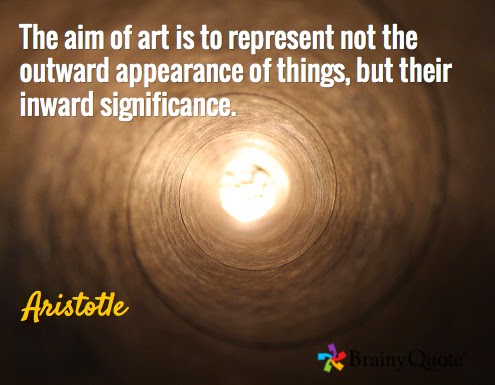
http://www.brainyquote.com/quotes/quotes/a/aristotle104151.html

We can't touch our readers, change hearts, and share God with others if we are not writing art onto the pages. And by that I mean:


So, when have you written your art out lately?

Saturday, January 10, 2015

The Writer's Alley Weekend Round Up

I don't know where you live, but it's been cold here in Texas. It is the time of year I love to light a fire and burrow under a warm, cozy blanket. The bad thing is that I don't want to get out from under the warmth and tend to waste time...staying warm. Of course, if you grab your laptop and open it up to one of your favorite writing blogs, then your time under the blanket is well spent. Make sure you stop by this week for some good reading and fun at The Writer's Alley.

Special Guest at The Alley

On Tuesday, Julia is hosting author, Cindy Sproles, who will be talking about writing and publishing challenging topics. Her book, Mercy's Rain, releases this month. Make sure to stop by


The Awesome Link Round Up

Six Things Every Writer Needs to Succeed (Writer UnBoxed)

How to Write Better Stories and Finally Win Out (Write to Done)

The Forest for the Trees: How to Cure Overwriting (Live Write Thrive)

Stirring Higher Emotions - Donald Mass (Writer UnBoxed)

The Best-Selling Books of 2014 (Publishers Weekly)

Face Your Fear the Wright Way and Write Your Best Work (Positive Writer)

In Praise of Quitting (Writer UnBoxed)

For Books, Print is Back (Publishers Weekly)


Friday, January 9, 2015

Men at ACFW--Do They Exist?

Casey here: I am thrilled to host my friend and up and coming writer, Andrew Swearingen on the blog here today. Earlier last year, there was a debate on the ACFW loop about men and their presence or lack thereof at the ACFW conference. And it got me to thinking--do we exclude men and their company at our conference or within our writing circles and community? Here's some interesting food for thought. Share your thoughts and experiences in the comments below. 


Last September I attended my first writer's conference, with ACFW, the American Christian Fiction Writers.

It was a great experience all around. I loved getting to meet other writers (published or otherwise) and I had plenty of opportunities to talk about my book with agents and editors.

In the weeks after the conference there was a conversation on the ACFW e-mail loop about “Men at
ACFW”. I've worked with the audio video team at the ACFW conference the last few years, so I knew that the organization was made up of mostly women. I thought maybe guys made up maybe ¼ of the conference demographic. Nope. It's more like 15%. One man felt ostracized during the large group sessions, feeling out of place. After all, this used to be American Christian Romance Writers. So the question came up, is there a place for the Y chromosome in ACFW?

For my part, I didn't feel left out in any way. It's true, as a single guy in my 20's, I definitely stood out among the ACFW crowd, but I knew that would be the case going in.

If anything, the hard part was engaging with such a large crowd. However, when the rubber hit the road, we were all writers and we all had plenty to talk about. Most everyone I spoke with was friendly and excited to talk about their book.

(If I can be very honest, I think my history of putting my foot in my mouth has helped me get over my fear of looking foolish.)

But just for sake of argument, let me list the ways that it was difficult being in the “male minority” at ACFW.

1.) It's awkward being the only guy at a table full of women.
2.) It's awkward being a 20-year-old guy at a table full of middle aged women.
3.) It's awkward walking into dinner in a group of all women. (You may have noticed a pattern here. I won't belabor the point.)
4.) Lot of pictures taken of me and with a bunch of women. (some guys would love this, but that's another issue).
5.) Being the default picture taker when the ladies see a photo op.
6.) Telling a female writer that you write Sci-fi and she replies “Oh that's so cute. My 5-year-old son loves Star Wars.”
7.) I had no idea who Lauraine Snelling was (still don't).
8.) Having nothing to contribute when the “Romance Moms” start talking about their grandkids.
9.) Having to be very careful introducing when myself to young female writers (Give me a t-shirt that says “No really, I only want your phone number for networking purposes.”).
10.) Seriously though? There were so few male role models at the conference. I know they're there, but man, as far as speakers, I feel like we guys come away wanting more. I didn't really notice it until Allen Arnold, a speaker from Ransomed Heart Ministries, got up to lead the morning devotionals. Granted Allen is a fantastic speaker who knows how to address the hearts of artists, but his fatherly presence was such a breath of fresh air to me. (I will add the caveat that I am chronically bad at meeting with and talking to men I look up to, which may be part of why I felt so dry in that regard).

However, there are a few upsides of being in the male minority


1.) No lines at the restroom.
2.) Lots of excited women, telling you how glad they are to see more men.
3.) You know who your friends are. It's not like you get to pick and choose. When there are only so many men at the conference, you have little choice but to network with the few guys you meet with.
4.) Realizing that the women don't bite (most of them at least). Even with more and more men attending ACFW, we still need to interact with the other 85%. So this awkward Sci-fi writer needs to cross the aisle and make connections with a few women. And it's not even that bad. Despite the intimidation factor when trying to engage a pack of women, once the conversation starts, most of them are pretty easy to talk with.

5.) I learned to look at the genre, not the gender. Some of the most impactful story talks I had were with members of the fairer sex. And I'm willing to bet that I learned a thing or two from their feminine insight.
6.) Genre crossover. While we joke about the rival “clans” of writers, we can all learn a bit from each other. Some things won't change. Romance writers will always think Spec Writers are a little “out there”. Suspense writers will tell Romance writers to “pick up the pace” and ask “when will there be a dead body”? But we all have something that we can learn from one another. Romance writers can help spice up the romance between the swashbuckling hero and his damsel in distress. Suspense writers can help the Romance writers toss in a plot twist or two. (And we Spec writers can help all of you realize that whatever story issue you're having can easily be solved by the introduction of a Robot Apocalypse).
7.) Unique voice. Amid the season of female voices in a conference like ACFW, male voices are in short supply. It doesn't guarantee anything. You still need to have something that stands out, but it does give us guys a unique position to bargain from.
8.) ACFW Mom's. I have no fewer than 5 mom's in ACFW and it's fantastic. Sometimes after a rough agent appointment, a little hug from “Mom” can go a long way.
9.) Oh and did I mention that my protagonist is a 17-year-old girl? Yeah, female insight into the mind of a moody (telepathic) teen can be quite useful.
10.)  Realizing that maybe, just maybe, it the gender gap isn't as big of a deal as some people would like to make it out to be.

Would things maybe be easier if ACFW were even 30% male? Sure. I long for the day when there are more and more men writing in the Christian market. “As iron sharpens iron, so one man sharpens another.” There is something unique that we men get when men can challenge and encourage one another in our endeavors. It has nothing to do with “the dominant sex”. There are ways that men can speak into one anothers lives that women just cannot (and vice versa).

But networking, like so much of life, is not based on working with ideals. You take what you have and you make it work. We musn't get hung up on the “shoulda, woulda, coulda”. 
If more men come, then great. Fantastic. They'll be invaluable additions to the conference. But even if they don't, I'll still be glad to be a member and proud to call each and every one of those amazing folks family


************************

A lover of all things Sci-fi, Andrew Swearingen writes Speculative fiction, usually involving swashbuckling super heroes, powerful starships, and the occasional killer robot. He works a “real job” for a landscaping company and serves in his church's kids program.


Thursday, January 8, 2015

The Writing Business: Making Goals

Every good business has goals.

If you're viewing your writing as a business (i.e. you want to sell your writing some day to make some type of monetary income from it vs just giving it away...) then you need them!!!

And the new year is a GREAT time to make them.

Goals can come in all shapes and sizes, and highly depend on where you are at in the process.

Are you still a newbie, working on that first manuscript? So maybe a daily/weekly/monthly word count goal would be a appropriate, or a date to finish your first manuscript by.

Are you past that, looking to find an agent/next step? Then maybe make a list of some good concrete steps you can take toward that. Query X numbers of agents. Attend X number of conferences. Read X number of craft books (we can ALL do that one!)

Or maybe you're already published, so your goals will include actual sales numbers or # of books to write or steps to growing your "tribe" or network or platform, whatever you want to call it.

But what makes a good business goal?

Here are my tips --

1.) Be specific. "Write more" is a good goal if writing is your hobby. But it's not a good business goal. "Write 1,000 words a day, 4 times a week" is an example of a good, specific business goal. The numbers are going to vary for each of us.

2.) Be attainable. "Write 5,000 words 6 days a week" is not really an attainable goal. Most of us have 5,000 word days, but not 6 days a week throughout the year. Setting unrealistic goals sets you up for failure.

3.) Be aggressive. Yes, you want attainable goals. But puny goals  will equal puny results. A good rule of thumb is to figure out what you are doing NOW, and plan an increase. Are you writing about 300 words a day now? Shoot for 500. Are you writing 500? Shoot for 750 or 1000. Are you writing 2 days a week, maybe go for 3. Setting your expectations TOO low is self-defeating.

4.) Be flexible. Regardless of how you set your goals, be flexible. Things may happen to change them. There is nothing to say you can't revise your goals to reflect changes in life or reflect God's leading. Because goals are great and wonderful, but nothing can replace the prompting of the Holy Spirit. Find yourself spending too much time on writing and God urges you to focus on family? Revise those goals accordingly. Don't be so focused on your goals that you tune out the voice of God. This goes for ALL goals in your life!

So, how about it? Have you made writing goals for 2015? Feel free to share!!

*************************************************
Krista is a follower of Jesus, a wife, a mother, and author of Sandwich, With a Side of Romanceand A Side of Faith. She blogs about finding JOY in the journey of LIFE at http://www.kristaphillips.com. She is represented by Sarah Freese of Wordserve Literary.

Wednesday, January 7, 2015

Character Personality Class.1-Outgoing.Observant.Outspoken


Today begins our Character Personality Class. Classes will be held every other Wednesday starting today.


Photo Courtesy

Back in December I mentioned my dislike for completing the tedious forms that asked fifty plus questions about each of my dominant characters. To me the questions often cause me to create useless information (birthdate, favorite food, etc) that I either never use or only add a layer of superficial boring details rather than help me dig into the character's gut feeling and subsequent response.

The purpose of knowing a character's personality is to help the writer know what typically plays out in a given situation. A character's response can change the flow of an entire scene. 

Determining the personality does not put a character in a box. No, not at all. I will provide you with an extensive list of characters who display each of the personality types. From this, you will be able to see the vast freedom your character has to respond in a logical way specific to them.

The benefit to understanding your character's personality is knowing what he/she would think and do when faced with, say, the last petal of a daisy and the words he/she loves me not. Or the physical response when your character is the last one holding the gun in a game of Russian Roulette. 

My qualifications: I have a Masters in Guidance and Counseling and have worked in this field for more than ten years. I am also a fiction writer and speaker.

Let's get started with Personality One: Outgoing. Observant. Outspoken. Spontaneous


The Joker          Nickie Ferrante
This character can be the aggressive villain or the suave star viewers/readers fall in love with.

He is outgoing: characterized by masterminding plots, Joker, sweeping a forbidden love off their feet, Nickie. He is engaged with those around him without a shred of loyalty to the following.

The more his friends laugh and seek him out the more successful he feels. At some point, though, he will grow tired of them, cast them away, and seek new followers.


Miranda Priestly       Scarlett O'Hara
She is observant. Able to rise to management and can turn a failure into a success. Hands-on: struggles to fully delegate. Checks on tasks, never quite trusting those under them.

She keeps people on their toes. Her followers/friends never know what she will poke fun at next. It will not be kind. "Is my coffee ready? Has she died?"

She is gregarious and proud of the fact that the masses want to be around her Scarlett...be her, Miranda.


Four                    Thorin Oakenshield

He is athletic. Enjoys extreme sports. He is naturally coordinated which enables him to pursue elements of danger like rock climbing, bungie jumping, windsurfing, jousting, train jumping, dragon slaying, killing the Azog, the Orc chieftain, and etc.

He is spontaneous, ready to initiate an activity, program, policy, for the-what-he-understands-to-be-right/best. A divergent.


Robin Hood, James T. Kirk, Gaston
Mrs. Smith, Cleopatra, M

She is outspoken, objective, logical, perceiving, responsive, adventurous.

Satisfaction chiefly comes in a new opportunity. Motivation is fueled by a desire to reach the goal.

Each of the characters in the photos have the personality discussed in today's class. Take a minute to look at the photos and consider the character (not the actor). Would you have invited them to your New Year's Eve party? Why or Why not?


For the sake of giving this personality an easy to remember label, this one will be called the Joker/Scarlet Personality. As you consider the characteristics of this outgoing, observant, outspoken, and spontaneous character take quiz below to check your working understanding of his or her response to the given situations:


1.  While at a ball or state function
    a. he would dance with his true love for most of the dances.
    b. he would ignore a spill caused by the server.
    c. he would keep a lively conversation at the dinner table.
    d. he would encourage others to speak

2. Each day
    a. she rises early with an agenda in her head
    b. she wishes for five more minutes of sleep
    c. she prefers to shop then stop at the coffee shop rather than go to work, but goes to work anyway
    d. she dreams of a strong man to sweep her off her feet

3. His New Year's Resolution might be:
    a. start a volunteer program to help the homeless
    b. organize/clean/polish his weapons/tools
    c. hike Mt. Everest
    d. write a novel

4. After a long day at work she prefers to:
    a. sip a cup or glass of her favorite beverage and put her feet up
    b. go out with her friends
    c. run errands
    d. catch up with social media

5. When personal tragedy strikes:
    a. he seeks the company of friends
    b. punches a wall or breaks something
    c. hides in his room for days, unwilling to eat or drink
    d. frustration and heartache rip him apart on the inside but he pulls himself together to act 

6. Which character would not be an example of the Joker/Scarlett Personality?
    a. Iron Man
    b. Sherlock Holmes
    c. 007
    d. Hans Solo
    (Bonus- why would the character you chose not be an example of the Joker/Scarlett Personality?)


How did you do? Here are the answers: 1. c  /2. a  /3. c  /4. b  /5. d  /6. b


What would happen if a Joker/Scarlett personality (outgoing, observant, outspoken, and spontaneous) discovered a secret code? Tell two things the character might do. 

Would this character be in any of your WIP? If so, take a moment and consider their scenes.  Did he or she respond true to their personality? Can you deepen the scene by modifying or including something only this personality might do? 

Feel free to ask questions in the comment section! I hope to see you at our next class in two weeks.

Information for this series has been gathered from sources focusing on Carl Jung's personality assessment works and include: 
Myers. "The 16 MBTI® Types." The Myers and Briggs Foundation. The Myers and Briggs Foundation, 2014. Web. 29 Dec. 2014.;
Smith, Daniel. How to Think like Sherlock: Improve Your Powers of Observation, Memory and Deduction. New York: MJF, 2012. Print.
Myers, David G. Psychology. 10th ed. New York: Worth, 2013. Print.

 *****************************************************************************************

If you found any typos in today's post...Mary Vee, (that's me sheepishly grinning), is waving her hand as the guilty party. 

Mary has moved to Michigan with her husband, closer to her three college kids. She misses the mountains of Montana, but loves seeing family more often. She writes young adult mystery/adventure Christian fiction, is honing marketing and writing skills, and loves to pen missionary and Bible adventure stories on her ministry blog, God Loves Kids.

Visit Mary at her website and her ministry blog to families: God Loves Kids. Or chat on Facebook or Twitter

Tuesday, January 6, 2015

A Pantser's Plotting Plan


I am not a plotter. This is no secret if you know me or have read any of my blog posts. My stories start with characters, and the plot comes along as I go. In the past, I’ve maintained that plotting stifles creativity in my case. But I want to go on record and amend this statement.


It’s all the time wasted banging my head on the keyboard wondering what to write next that stifles my creativity.


For the first time in the history of my life, I’ve discovered a plotting book that doesn’t make my eyes glaze over after the first chapter. In fact, I'm almost finished!


It’s well-written, informative, and doesn’t have the confusing code language some of the other ones seem to have. The focus of Jordan Rosenfeld's Make a Scene is building a story intentionally based on each scene. Stories tend to come to me in glimpses anyway -- kind of like movie clips -- so this approach works. But the key I need to work on is developing a framework so I don’t have to do so much editing and reworking after my first draft. I need the puzzle box with the big picture to help me piece it together, so that if and when I become a published author, I can deliver my finished product in a timely manner with as little stress possible. :)


Writer friend Jessica Patch recommended this book to me, and I’m so glad. As you can see from the notebook above, I’ve been going all Hermione Granger on it with several pages of notes over the holidays. I’ll be sharing much more about what I’m learning later, but for starters, this is my tentative plan for how I’m going to plot my current manuscript:


Character studies. I wrote an entire blog post on what goes into this process for me not too long ago, but to sum up, I learn about their quirks, deepest desires, the ways they sabotage themselves, and what sets them apart as people I’d enjoy talking to over a slice of pizza.


Plot threads. Hopefully in the above step, I’ve learned at least the gist of what my main characters will learn and how they’ll grow throughout the story (the heart of the manuscript!). So my next step is to write out a shortish sort of synopsis for each of my storylines -- as much as I know about them already, anyway.


For example, continuing the theme of Pepper’s post yesterday, if I were doing this for the Lord of the Rings series, I’d have one “synopsis” for the ring’s journey from Bag End to Mordor, one for Aragorn’s ascent to king, one for the Battle of Helm’s Deep, one for Aragorn and Arwen’s love story, etc.


It sounds complicated, but it really helps. I think having a map like this up front will show me what to focus on and how to most effectively strengthen each plotline (and consequently each main character's journey) in relation to the others.


Scenes. From there, I can separate the sequential events of the synopsis into bullet points and then imagine specific scenes to flesh out these bullet points and further my story. For this step, I will likely stick to my pantser roots and write as I go. But having the map shaped in the previous steps will help me keep my characters on track and hopefully give me purpose for each writing session. I can’t emphasize how much the Make a Scene book has helped me in terms of being intentional/impactful with each scene!

So that’s the tentative plan for how this pantser is going to try her hand at plotting. I have all the essentials to make this work.


Now to stop planning and WRITE. Hopefully word count will be spared, the delete button will get a rest, and any unnecessary *facepalm* moments will be avoided.

Are you a plotter, pantser, or as Casey calls it, a hybrid "plotster"? Any tips or tricks that have worked for you?

---

Laurie Tomlinson is a wife and mom from Tulsa, Oklahoma, who enjoys stories of grace in the beautiful mess. 

She is a member of the American Christian Fiction Writers and received the Genesis Award in 2013 (Contemporary) and 2014 (Romance). 

Her work is represented by Rachel Kent of Books & Such Literary.

You can connect with Laurie here:

Twitter - @LaurieTomlinson


Monday, January 5, 2015

Character Care in LOTR vs The Hobbit movies


Time to start some healthy controversy :-)

Let’s talk about character development in two of the most anticipated series out in the past 10 years. The Lord of the Rings and The Hobbit.

Since I’m talking about characters in fantasy novels, I figured if I posted a picture of Aragorn it would appeal to the romance writers out there too, right? :-) And WHAT a hero!

So, let’s talk.


The Hobbit was written for a younger audience than The Lord of the Rings Trilogy

The Hobbit is one novel that was stretched over 3 movies whereas LOTR had 3 books to fit the movie number.

And let’s face it – the INCREDIBLE cast chosen for LOTR was a once-in-a-lifetime pairing of artists and personalities which was pretty impossible to match in The Hobbit.

So with those in mind, let’s talk Character Development.

I am big Tolkien fan, so when LOTR came out in movie form, I was thrilled. For the most part, Peter Jackson did a great job portraying the heart of the story and he gave viewers a visually thrilling introduction to the world of Middle Earth. With a large cast of characters, it can be a little difficult to make the viewer/reader really care about any one character, but in the movies, Jackson does this so well. In LOTR, in particular, viewers are invited to care about A LOT of characters - and we do! What happens here? How does the ‘care’ of the characters create a deeper development in one series over another?

He builds care through relationships.

We care about the characters because of the evidence that other people care.

This happens in much more depth in LOTR than in The Hobbit trilogy. The fellowship of the 9 have various elements of camaraderie before they are brought together, so when they start their relationships as a Fellowship, it makes the story even stronger. Aragorn and Legolas are clearly good buds, Gandalf has a relationship (of sorts) with all of them, the four Hobbits have been raised around each other for years. Even if the relationships begin as somewhat antagonistic (Legolas & Gimli), there is a connection.

The Hobbit trilogy doesn’t build the same depth of character relationships as LOTR, which leads to viewers feeling less of a connection to the characters. Of course, the dwarves add some humor in the beginning, Tauriel and Kili are sweet, and the relationship between Bilbo and Gandalf is cute, but as far as developing the kind of ‘care’ as LOTR? It isn’t the same. One of my favorite characters in the whole Hobbit Trilogy is Bard, especially as we get to know his character more in the third movie – but this, again, is due to his relationship as a father and leader. The relationships, the interaction, builds the care.

(Smaug is AWESOME, btw,  but because he’s a dragon and voiced by Benedict Cumberbatch)

As a writer - how do you use relationship to develop 'care' in your characters? What does the relationship your main characters have with each other tell us about them? How does it deepen their characterization?

He builds care through basic characterization

In LOTR we learn pretty early on that Pippin is the jokster and risk-taker, Samewise is the faithful one, Gimli is the comic relief, Gandalf is the wise mentor, Aragorn is the honest warrior. In the books and in the movies, the characterization of these characters helps readers and viewers to develop a kinship or likeability with them. There’s comfort, humor, and compassion that comes with the predictability in their characters.

In The Hobbit, it was a more thinly presented characterization. In my opinion, even over 3 movies, I didn’t get to know any of the characters well enough to feel confident in predicting their behaviors – except maybe Bilbo and Bard.

So what do you do as a writer? Does your character have endearing quirks? How do you 'show' who they are through they way they interact with their environment and world? Their clothing choices? How they drive a car? Do they clean their house on a schedule or as the mood hits? All these seemingly small things can deepen characterization and thus the reader's care.

He builds care through character choices.

It seems to be a pretty common thought that we care about good people more than bad people (unless they are fantastic villains, then we may just enjoy their appearance on the page), and individuals in movies and books show their ‘goodness’ or ‘badness’ through the choices they make. I must take the time to mention Samwise Gamgee here. WOW! His example of friendship and faithfulness in LOTR is beautiful and definitely ‘quote-worthy’.

“I can’t carry it, Mr. Frodo, but I can carry you.”

Okay, I digress.
Aragorn’s constant acts of heroism and sacrifice, Merry & Pippins companionship, Gandalf’s self-sacrifice and wisdom … there are so many. The choices make give us a deeper understanding of who they are - and who they are willing to become.

The same is true in the Hobbit, but it never quite goes as deep and close as LOTRs. Bard’s choices to save the town is certainly a reason to care for him (and the fact he loves his kids), Bilbo’s choices to save his friends (on several occasions).

The choices your characters make help to build the reader's connection to them. When the characters win, lose, and how they seek forgiveness for their mistakes. Boromir in his epic death scene trying to 'redeem' himself from his choices - and even asks forgiveness of Aragorn. Thorin asking for forgiveness from Bilbo (which helps us end with good thoughts about Thorin who had pretty much been a grumpy pants the entire movie)

So what are your thoughts?

Why do you CARE about the characters you read or write?